


Home › Non-Surgical Lifting › Skin Boosters
Non-Surgical Lifting
Skin Boosters in Seoul, Korea: Types, Results and What to Expect
By the Facelift in Korea Editorial Desk · Independent · How we report
The short answer
Quick answer: Skin boosters are injectable treatments placed in many small amounts across the skin to improve hydration, texture, fine lines and glow. In Seoul they include hyaluronic acid boosters, polynucleotides such as Rejuran, and collagen stimulators such as Juvelook. They do not lift sagging. Most plans involve two to four sessions a few weeks apart.
What are skin boosters?
"Skin booster" is a broad term for injectable treatments that aim to improve the quality of the skin rather than change facial shape. The product is placed in many tiny amounts across an area, close to the surface. The goal is better hydration, smoother texture, finer pores and a healthy glow.
Skin boosters are not fillers in the traditional sense. They do not create contour or lift sagging tissue. Instead, they are a skin-care step that happens under the surface.
What types of skin boosters are used in Seoul?
Clinics in Seoul offer a wide range. The main groups are:
- Hyaluronic acid (HA) boosters. Soft, lightly cross-linked or non-cross-linked HA that attracts water into the skin. Examples include Restylane Skinboosters and similar products.
- Polynucleotides (PN). DNA-fragment injections such as Rejuran Healer, aimed at repair and elasticity.
- Collagen stimulators used superficially. Products such as Juvelook that combine lactic-acid polymers with HA.
- Combination "cocktails." Some clinics mix vitamins, peptides or other ingredients. Ask exactly what is in any mixture, and be cautious with unbranded products.
Who is a good candidate?
Skin boosters suit people who want better skin without changing how their face looks:
- Dry, dehydrated or dull skin
- Fine lines on the cheeks, under the eyes or on the neck
- Crepey texture or enlarged pores
- Skin that needs support after lasers or energy treatments
- People preparing for an event who want a fresh look
They are not suitable during active skin infection. People with autoimmune conditions, allergies or a tendency to keloids should discuss risks first. If sagging is the main concern, look at HIFU lifting or threads instead.
What happens during treatment?
Numbing cream is applied for about 30 minutes. The doctor then injects the product using a fine needle, a cannula or an automated injector that delivers many small doses quickly. A full-face session usually takes 20 to 40 minutes.
Afterward, small bumps or tiny marks may be visible for a day or two. Most people avoid makeup for several hours and skip saunas, swimming and intense exercise for a day.
How are skin boosters offered in Seoul?
Skin boosters are among the most common treatments in Seoul, often sold in packages of three sessions or bundled with devices. Visitors often book them early in a trip so any bumps have settled before sightseeing or photos.
Questions worth asking:
- Which exact product will be used, and is it opened in front of you?
- How much product will go into each area?
- How many sessions are recommended, and is a single session worthwhile?
- Will the booster be combined with any device on the same day?
Because many Seoul clinics combine boosters with HIFU or RF, ask the doctor to explain the order and why. Our registered foreign-patient clinics guide explains how to check a clinic's status.
What are the risks?
Side effects are usually minor: redness, swelling, small bumps and bruising. Less common risks include infection, lumps and allergic reactions. Vascular complications are rare but possible with any injectable. Avoid unlabeled "cocktails" and treatments outside medical clinics.
How long do skin boosters last?
Hyaluronic acid boosters often last around four to six months. Polynucleotides and collagen stimulators may give longer-lasting skin-quality changes after a full series. Many people schedule maintenance two or three times a year. Good daily skincare and sunscreen help you keep the benefit.
How do I choose the right skin booster?
Start with the problem, not the product. If your skin feels tight and dry, a hyaluronic acid booster may be enough. If it looks thin, sensitive or slow to heal, a polynucleotide may suit you. If you want gradual firming and finer texture, a collagen stimulator may make sense.
A good doctor will explain the choice in plain language, tell you how many sessions are needed and how long each result is likely to last. Be wary of packages that bundle many products without a clear reason. If you see the term "exosome" in a booster menu, read our exosome therapy page first.
This page is general information, not medical advice. Decisions about surgery should be made with a qualified, board-certified plastic surgeon after an in-person examination.
Key facts
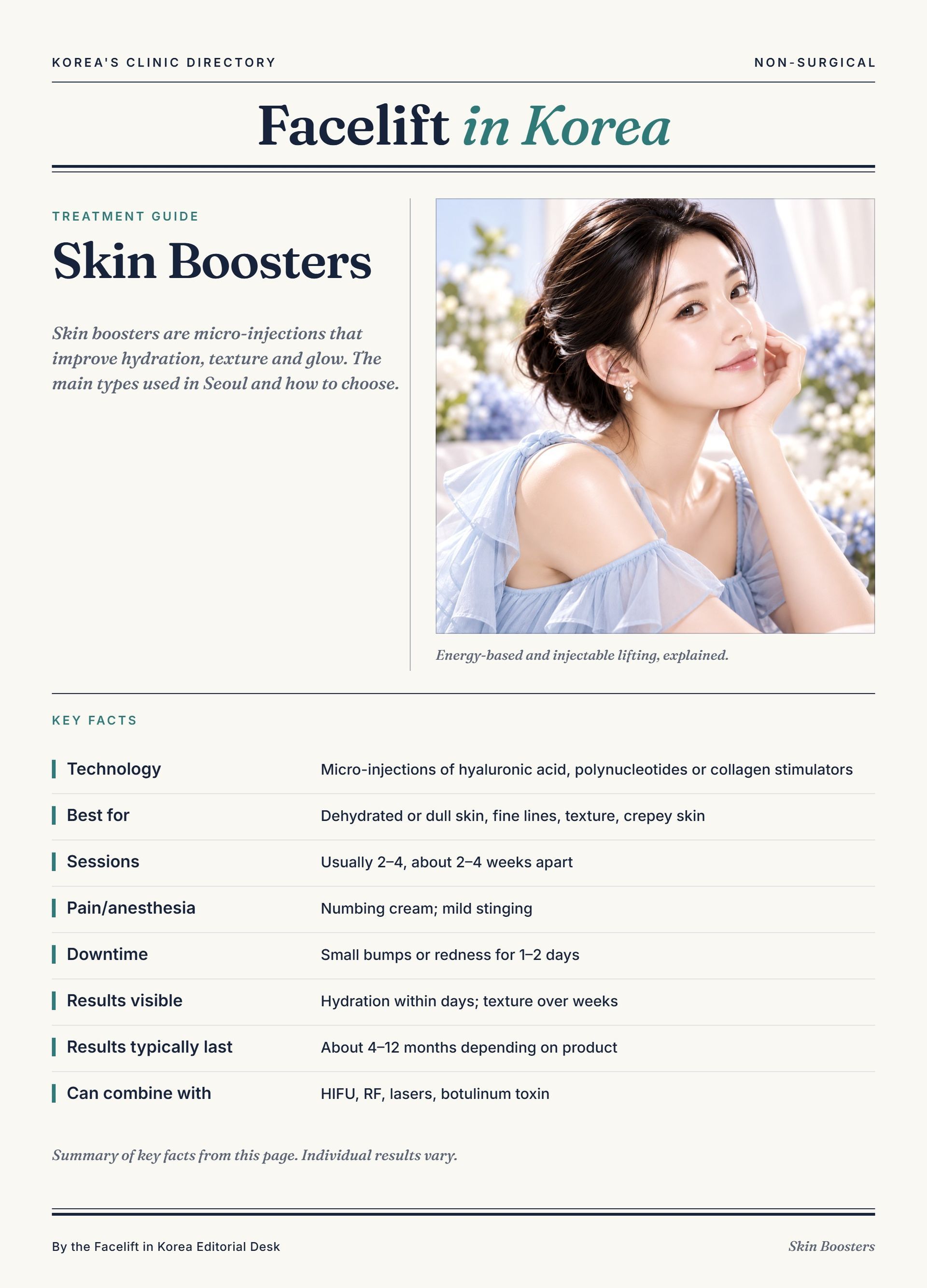
| Technology | Micro-injections of hyaluronic acid, polynucleotides or collagen stimulators |
|---|---|
| Best for | Dehydrated or dull skin, fine lines, texture, crepey skin |
| Sessions | Usually 2–4, about 2–4 weeks apart |
| Pain/anesthesia | Numbing cream; mild stinging |
| Downtime | Small bumps or redness for 1–2 days |
| Results visible | Hydration within days; texture over weeks |
| Results typically last | About 4–12 months depending on product |
| Can combine with | HIFU, RF, lasers, botulinum toxin |
| Price guide | Non-surgical lifting cost in Korea |
Read next
Reader questions
Frequently asked questions
What do skin boosters do?
Skin boosters improve hydration, texture, fine lines and glow by placing small amounts of product in the skin. They do not lift sagging or change facial shape.
How long do skin boosters last?
Hyaluronic acid boosters typically last about four to six months. Collagen-stimulating or polynucleotide boosters may last longer after a full series.
Are skin boosters the same as fillers?
No. Fillers add volume and shape. Skin boosters are spread thinly across the skin to improve quality, not contour.
How many skin booster sessions do I need?
Most plans involve two to four sessions spaced two to four weeks apart, followed by maintenance every few months.
Which skin booster is best?
It depends on your goal. Hyaluronic acid is mainly for hydration, polynucleotides for repair and elasticity, and collagen stimulators for gradual firming. Your doctor should explain why a specific product is recommended.
Next steps
Planning a facelift in Korea?
Compare clinics, check surgeon credentials and estimate your full trip budget before you book a consultation.
Facelift in Korea is an independent information directory. We do not perform procedures, and listings are not endorsements. This page is general information, not medical advice.