


Home › Non-Surgical Lifting › Rejuran Healer
Non-Surgical Lifting
Rejuran Healer in Seoul, Korea: Polynucleotide Skin Treatment
By the Facelift in Korea Editorial Desk · Independent · How we report
The short answer
Quick answer: Rejuran Healer is an injectable made by PharmaResearch in Korea. It contains polynucleotides (PN), DNA fragments purified from salmon, which are used to support skin repair, hydration and elasticity. It is approved by Korea's Ministry of Food and Drug Safety. Most people have three sessions about three to four weeks apart, with small bumps for a day or two.
What is Rejuran Healer?
Rejuran Healer is an injectable treatment from PharmaResearch, a Korean pharmaceutical company. Its active ingredient is polynucleotide (PN), made of purified DNA fragments sourced from salmon. Rejuran is one of several Korean products in this category, and "Rejuran" has become a common name for PN injections in general.
Polynucleotides are thought to support the skin's own repair processes, improve hydration and help the dermis function better. They are not fillers and do not lift tissue. Their role is to improve skin quality over a series of sessions.
How is Rejuran different from other skin boosters?
Skin boosters work in different ways:
- Hyaluronic acid boosters mainly hydrate and plump the skin.
- Collagen stimulators such as Juvelook trigger new collagen.
- Polynucleotides like Rejuran aim to support repair and regeneration.
Many Seoul clinics combine these approaches. For an overview, see skin boosters. Variants such as Rejuran HB (with hyaluronic acid and lidocaine) and Rejuran S (for scars) are also available.
Who is a good candidate?
Rejuran suits people focused on skin health rather than lifting:
- Dull, tired or dehydrated skin
- Fine lines and loss of elasticity
- Thin or sensitive skin
- Post-acne texture and shallow scars
- Skin recovering from lasers or energy treatments
People with a severe fish or seafood allergy should discuss this carefully with the doctor, as the product is salmon-derived. It is not suitable during active skin infection.
What happens during treatment?
Numbing cream is applied for 30 to 40 minutes. The doctor then injects small amounts across the face using a fine needle or an injector device. Rejuran injections are known to sting more than some other boosters, which is one reason variants with lidocaine were developed.
A full-face session takes about 20 to 30 minutes. Afterward, you will see small bumps at each injection point. These usually flatten within 24 to 48 hours. Avoid makeup for several hours, and saunas or intense exercise for a day or two.
How is Rejuran offered in Seoul?
Rejuran is one of the most popular skin treatments in Korea and is widely available in dermatology and plastic surgery clinics. It is usually priced per session or per syringe, with discounts for a package of three or four sessions.
For international patients:
- A single session gives a smaller effect than a full series. Ask whether one session is worthwhile on a short trip.
- Ask which Rejuran product will be used and how many syringes.
- Ask whether the product will be opened in front of you.
- Plan around the small bumps, which can be visible for a day or two.
If you are also planning RF microneedling or lasers, ask how the clinic sequences Rejuran with those treatments.
What are the risks?
Side effects are usually mild and temporary: stinging, small bumps, redness and occasional bruising. Less common are infection, persistent lumps and allergic reactions. Long-term data on aesthetic use is more limited than for older treatments, so choose a doctor who uses genuine product and gives clear aftercare advice.
How long do Rejuran results last?
Improvements build over the series and for some weeks afterward. Many clinics suggest maintenance sessions every six to twelve months. Results are subtle: smoother texture, better hydration and a healthier look rather than a lift. For sagging, see the surgical vs non-surgical facelift guide.
How should I care for my skin after Rejuran?
Aftercare is simple but worth following:
- Do not rub or massage the bumps; let them settle on their own
- Use a gentle cleanser and moisturizer, and skip strong acids or retinoids for a day or two
- Apply sunscreen daily
- Avoid saunas, jjimjilbang, swimming and heavy exercise for about 24 to 48 hours
- Avoid alcohol on the day of treatment if you bruise easily
If you notice increasing redness, warmth, pain or a lump that grows, contact the clinic. Ask for a phone number or messaging contact you can use after you leave Korea.
This page is general information, not medical advice. Decisions about surgery should be made with a qualified, board-certified plastic surgeon after an in-person examination.
Key facts
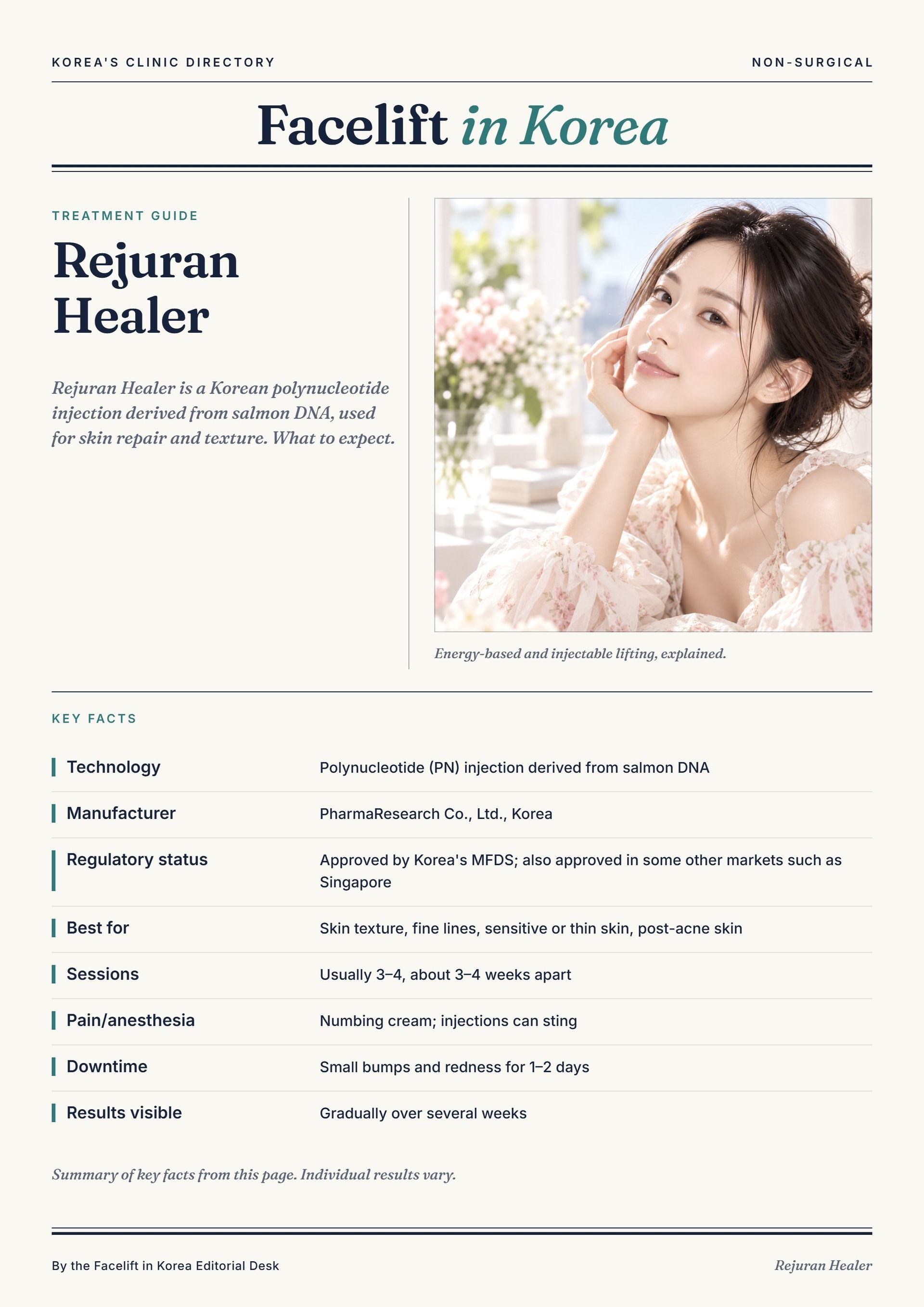
| Technology | Polynucleotide (PN) injection derived from salmon DNA |
|---|---|
| Manufacturer | PharmaResearch Co., Ltd., Korea |
| Regulatory status | Approved by Korea's MFDS; also approved in some other markets such as Singapore |
| Best for | Skin texture, fine lines, sensitive or thin skin, post-acne skin |
| Sessions | Usually 3–4, about 3–4 weeks apart |
| Pain/anesthesia | Numbing cream; injections can sting |
| Downtime | Small bumps and redness for 1–2 days |
| Results visible | Gradually over several weeks |
| Price guide | Non-surgical lifting cost in Korea |
Read next
Reader questions
Frequently asked questions
What is Rejuran made of?
Rejuran contains polynucleotides (PN), purified DNA fragments sourced from salmon. Some versions also contain hyaluronic acid and lidocaine.
How many Rejuran sessions do I need?
Clinics commonly recommend three to four sessions, about three to four weeks apart, followed by maintenance every six to twelve months.
Does Rejuran hurt?
Rejuran injections can sting, even with numbing cream. Versions containing lidocaine are designed to be more comfortable.
Is Rejuran approved?
Rejuran is approved by Korea's Ministry of Food and Drug Safety and is also approved in some other markets, such as Singapore. Approval status varies by country.
Can I have Rejuran if I am allergic to fish?
Tell the doctor about any fish or seafood allergy. Because Rejuran is salmon-derived, many practitioners avoid treating people with severe seafood allergies.
Next steps
Planning a facelift in Korea?
Compare clinics, check surgeon credentials and estimate your full trip budget before you book a consultation.
Facelift in Korea is an independent information directory. We do not perform procedures, and listings are not endorsements. This page is general information, not medical advice.