


Home › Non-Surgical Lifting › Exosome Therapy
Non-Surgical Lifting
Exosome Therapy in Seoul, Korea: What Is Proven and What Is Not
By the Facelift in Korea Editorial Desk · Independent · How we report

The short answer
Quick answer: Exosomes are tiny vesicles released by cells. In Seoul, "exosome therapy" usually means applying an exosome-containing product to the skin after lasers or microneedling, or sometimes injecting it. Evidence for aesthetic benefits is still limited. The US FDA states that no exosome products are approved, and injection-related adverse reactions have been reported. Approach these treatments with caution.

What are exosomes?
Exosomes are very small sacs, called extracellular vesicles, that cells release to send signals to other cells. They carry proteins, lipids and genetic material. Researchers are studying them in many areas of medicine, including wound healing and regeneration.
In aesthetics, products are marketed as containing exosomes from various sources, such as human stem cells, plant cells or other origins. The claim is that these signals can help skin repair and renew itself. That idea is scientifically interesting, but research on cosmetic use is still at an early stage.
How is "exosome therapy" offered in Seoul?
Exosome products became a major trend in Korean skin clinics. They are commonly:
- Applied to the skin straight after lasers, RF microneedling or microneedling, when tiny channels are open
- Added to skin "management" packages alongside boosters and devices
- Occasionally injected, sometimes as part of a booster cocktail
Many exosome products sold to Korean clinics are cosmetic products intended for topical use. Using a cosmetic product by injection is not the same as using an approved medicine or medical device. Korean regulators have also scrutinized exosome claims in cosmetic advertising. If a clinic offers to inject exosomes, ask what the product is approved for.
What is the regulatory status?
In the United States, the FDA has issued a public safety notification stating that there are currently no FDA-approved exosome products. It warned that some clinics market exosome products with unproven claims, and it reported serious adverse events in patients treated with unapproved exosome products. Exosomes intended to treat disease are regulated as drugs and biological products and require approval.
Rules differ in other countries, and products vary widely in source, purity and testing. Do not assume that a popular product in Seoul has been reviewed for safety and effectiveness as an injectable.
What does the evidence say?
Laboratory and early clinical studies suggest exosomes may influence inflammation and healing. However, high-quality clinical trials for cosmetic results are limited. Many marketing claims, such as dramatic anti-aging or lifting effects, are not supported by strong evidence.
Published case reports have described adverse reactions after exosome products were injected into the skin, including inflammation and, in at least one report, skin necrosis. These reports do not tell us how common such reactions are, but they are a reason for caution.
Who might consider it, and who should avoid it?
If you are interested, the lowest-risk use is usually topical application of a reputable, labeled product after a standard treatment, under a doctor's supervision. Even then, the benefit over ordinary post-procedure skincare is not well established.
People should be especially cautious, or avoid exosome injections, if they:
- Are pregnant or breastfeeding
- Have a history of cancer, autoimmune disease or poor wound healing
- Have allergies or sensitive skin
- Cannot get clear information about the product's source and approval
For proven options to improve skin quality, see skin boosters or Rejuran Healer.
Questions to ask a Seoul clinic
Before agreeing to any exosome treatment, ask:
- What is the exact product name and manufacturer?
- What is the source of the exosomes (human, plant or other)?
- Is it registered as a cosmetic, a medical device or a medicine, and in which country?
- Will it be applied to the skin or injected?
- What side effects has the clinic seen, and what is the plan if one occurs?
Write down the answers and the product name. If the clinic cannot answer clearly, that is useful information. Our guide on registered foreign-patient clinics explains how to check a clinic's status.
What results are realistic?
When used topically after a laser or microneedling, some people report calmer skin and faster recovery. It is hard to separate this from the effect of the main treatment and good aftercare. Exosome products do not lift sagging tissue. If lifting is your goal, look at energy devices, threads or, for more advanced sagging, surgery.
This page is general information, not medical advice. Decisions about surgery should be made with a qualified, board-certified plastic surgeon after an in-person examination.
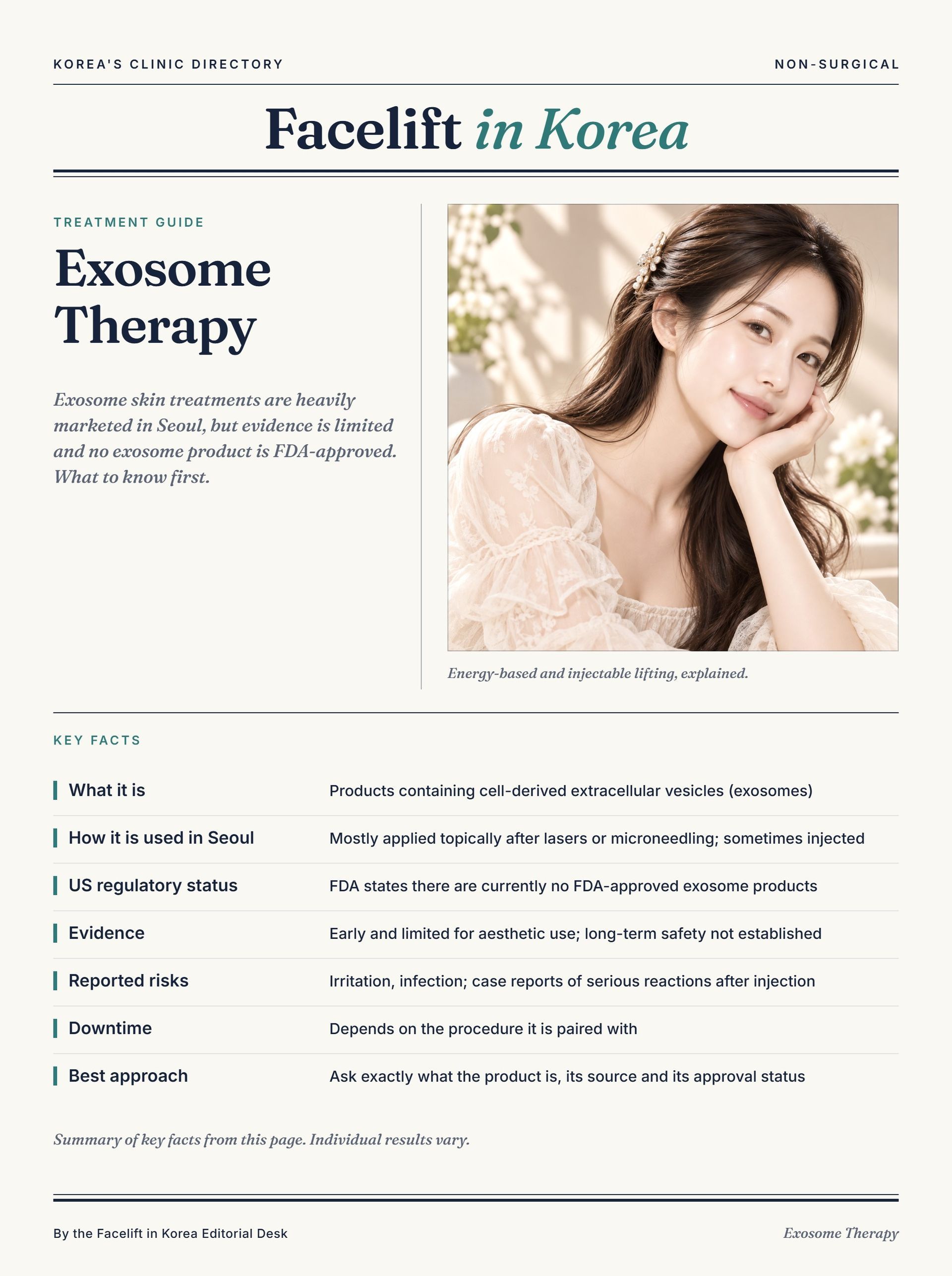
Key facts
| What it is | Products containing cell-derived extracellular vesicles (exosomes) |
|---|---|
| How it is used in Seoul | Mostly applied topically after lasers or microneedling; sometimes injected |
| US regulatory status | FDA states there are currently no FDA-approved exosome products |
| Evidence | Early and limited for aesthetic use; long-term safety not established |
| Reported risks | Irritation, infection; case reports of serious reactions after injection |
| Downtime | Depends on the procedure it is paired with |
| Best approach | Ask exactly what the product is, its source and its approval status |
| Price guide | Non-surgical lifting cost in Korea |
Read next
Reader questions
Frequently asked questions
Are exosome treatments FDA approved?
No. The FDA states that there are currently no FDA-approved exosome products. It has also warned about unproven claims and reported serious adverse events with unapproved exosome products.
Are exosome injections safe?
Safety has not been well established. Published case reports describe adverse reactions, including inflammation and skin necrosis, after exosome products were injected. Many products are intended only for topical use.
What does exosome therapy do for skin?
It is marketed to support repair and reduce redness after treatments like lasers or microneedling. Evidence for cosmetic benefits is still limited, and it does not lift sagging skin.
Why is exosome therapy so popular in Korea?
Exosome products became a strong trend in Korean skin care and clinic packages, often paired with lasers and microneedling. Popularity does not mean the evidence or regulatory review is complete.
What should I ask before getting exosome therapy?
Ask for the product name, manufacturer, source of the exosomes, regulatory status and whether it will be applied or injected. If answers are unclear, consider a better-established treatment instead.
Next steps
Planning a facelift in Korea?
Compare clinics, check surgeon credentials and estimate your full trip budget before you book a consultation.
Facelift in Korea is an independent information directory. We do not perform procedures, and listings are not endorsements. This page is general information, not medical advice.