


Home › Non-Surgical Lifting › Juvelook
Non-Surgical Lifting
Juvelook in Seoul, Korea: PDLLA Collagen Booster Explained
By the Facelift in Korea Editorial Desk · Independent · How we report
The short answer
Quick answer: Juvelook is a Korean-developed injectable that combines poly-D,L-lactic acid (PDLLA) microparticles with hyaluronic acid. It is used as a collagen-stimulating skin booster to improve texture, fine lines, pores and mild volume loss. Most people have two to three sessions about a month apart. Results build over three to six months and are often maintained yearly.
What is Juvelook?
Juvelook is an injectable developed in Korea that belongs to the group of collagen stimulators. It combines two ingredients:
- PDLLA (poly-D,L-lactic acid): a biodegradable polymer, related to the PLLA in Sculptra, made into fine microparticles. These trigger the skin to produce new collagen over time.
- Hyaluronic acid (HA): a hydrating molecule that gives a short-term plumping and moisturizing effect.
The product is reconstituted before use and injected into the skin or just beneath it. A related, more volumizing version, marketed as Juvelook Volume, is used for deeper volume support.
How does Juvelook compare with Sculptra?
Both are lactic-acid-based collagen stimulators, but they are used in slightly different ways:
- Material: Juvelook uses PDLLA with HA; Sculptra uses PLLA.
- Depth: Juvelook is often injected more superficially, for skin quality; Sculptra is placed deeper for volume.
- Goal: Juvelook is usually marketed as a skin booster for texture and fine lines; Sculptra for structural volume restoration.
- Regulatory record: Sculptra has a long US FDA approval history. We could not confirm a US FDA approval for Juvelook; ask about its registration status in Korea.
Our Sculptra vs Juvelook page goes into detail.
Who is a good candidate?
Juvelook suits people who want better skin quality with gradual, subtle firming:
- Fine lines and crepey texture on the cheeks
- Enlarged pores or shallow acne scars
- Early volume loss that does not need a full filler
- Thin skin under the eyes, if the doctor considers it appropriate
It will not lift sagging tissue. People with active skin infections, autoimmune conditions or a history of keloids should discuss risks first.
What happens during treatment?
After numbing cream, the doctor injects small amounts across the treatment area, using a needle, a cannula or an injector device. Many small injection points are typical when the goal is skin quality.
A session usually takes 20 to 40 minutes. Afterward, you may see small raised bumps at injection points, which usually settle within a day or two. Gentle massage may be recommended. Avoid makeup for several hours and saunas for a day or two.
How is Juvelook offered in Seoul?
Juvelook is one of the most talked-about skin boosters in Seoul, often offered alongside Rejuran and hyaluronic acid boosters. It is commonly priced per session or per vial, with packages of two or three sessions.
Tips for international patients:
- Ask whether you are getting Juvelook or Juvelook Volume, and how many vials
- Ask for the product to be opened in front of you
- If you cannot stay for a full series, ask whether a single session is worthwhile
- Record the product, dose and areas so a doctor at home can continue
Read skin boosters for the wider category.
What are the risks?
Common effects are redness, swelling, small bumps and bruising. Less common risks include persistent nodules, infection and pigment changes. As with any injectable, vascular complications are rare but possible. Choose a doctor who uses genuine product, explains the plan and arranges follow-up.
How long does Juvelook last?
Collagen builds gradually over several months. Many clinics suggest maintenance about once a year after an initial series. Results depend on age, skin quality and lifestyle. Daily sunscreen, not smoking and good skincare help protect the collagen you build.
Can Juvelook be combined with other treatments?
Yes. Juvelook works on skin quality, so it is often paired with treatments that act on other layers:
- HIFU or monopolar RF for deeper firming
- Botulinum toxin for expression lines
- Hyaluronic acid filler for specific volume or contour needs
- Polynucleotides such as Rejuran for repair
On a short trip, a doctor may combine several of these in one or two visits. Ask about the order, total cost and expected swelling, and keep a written record of everything injected. Clear records make it easier for a doctor at home to continue the plan safely.
This page is general information, not medical advice. Decisions about surgery should be made with a qualified, board-certified plastic surgeon after an in-person examination.
Key facts
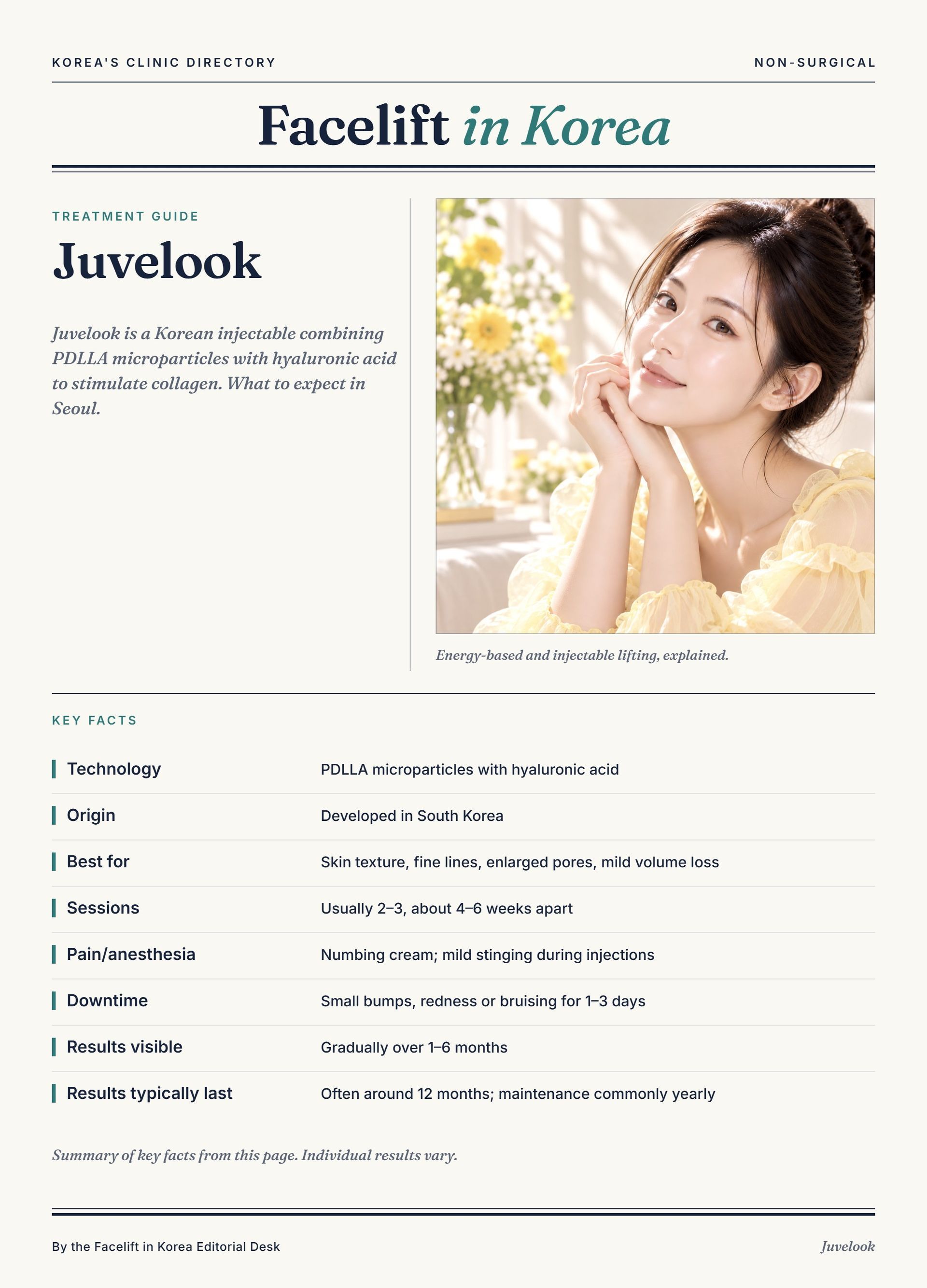
| Technology | PDLLA microparticles with hyaluronic acid |
|---|---|
| Origin | Developed in South Korea |
| Best for | Skin texture, fine lines, enlarged pores, mild volume loss |
| Sessions | Usually 2–3, about 4–6 weeks apart |
| Pain/anesthesia | Numbing cream; mild stinging during injections |
| Downtime | Small bumps, redness or bruising for 1–3 days |
| Results visible | Gradually over 1–6 months |
| Results typically last | Often around 12 months; maintenance commonly yearly |
| Price guide | Non-surgical lifting cost in Korea |
Read next
Reader questions
Frequently asked questions
What is Juvelook made of?
Juvelook combines poly-D,L-lactic acid (PDLLA) microparticles with hyaluronic acid. The PDLLA stimulates collagen, and the hyaluronic acid adds short-term hydration.
How many Juvelook sessions do I need?
Most people have two to three sessions spaced about four to six weeks apart. Your doctor will suggest a plan based on your skin and goals.
Is Juvelook the same as Sculptra?
No. Both stimulate collagen, but Juvelook uses PDLLA with hyaluronic acid and is often used for skin quality, while Sculptra uses PLLA and is often placed deeper for volume.
Is Juvelook FDA approved?
We could not confirm a US FDA approval for Juvelook. It was developed in Korea and is widely used there. Ask your clinic about its local registration status.
When will I see results from Juvelook?
Some people notice smoother skin within weeks. The main collagen effect builds over three to six months.
Next steps
Planning a facelift in Korea?
Compare clinics, check surgeon credentials and estimate your full trip budget before you book a consultation.
Facelift in Korea is an independent information directory. We do not perform procedures, and listings are not endorsements. This page is general information, not medical advice.