


Home › Comparisons › MINT vs Standard PDO Threads
Comparison
MINT vs Standard PDO Threads: How Thread Lift Types Compare
By the Facelift in Korea Editorial Desk · Independent · How we report
The short answer
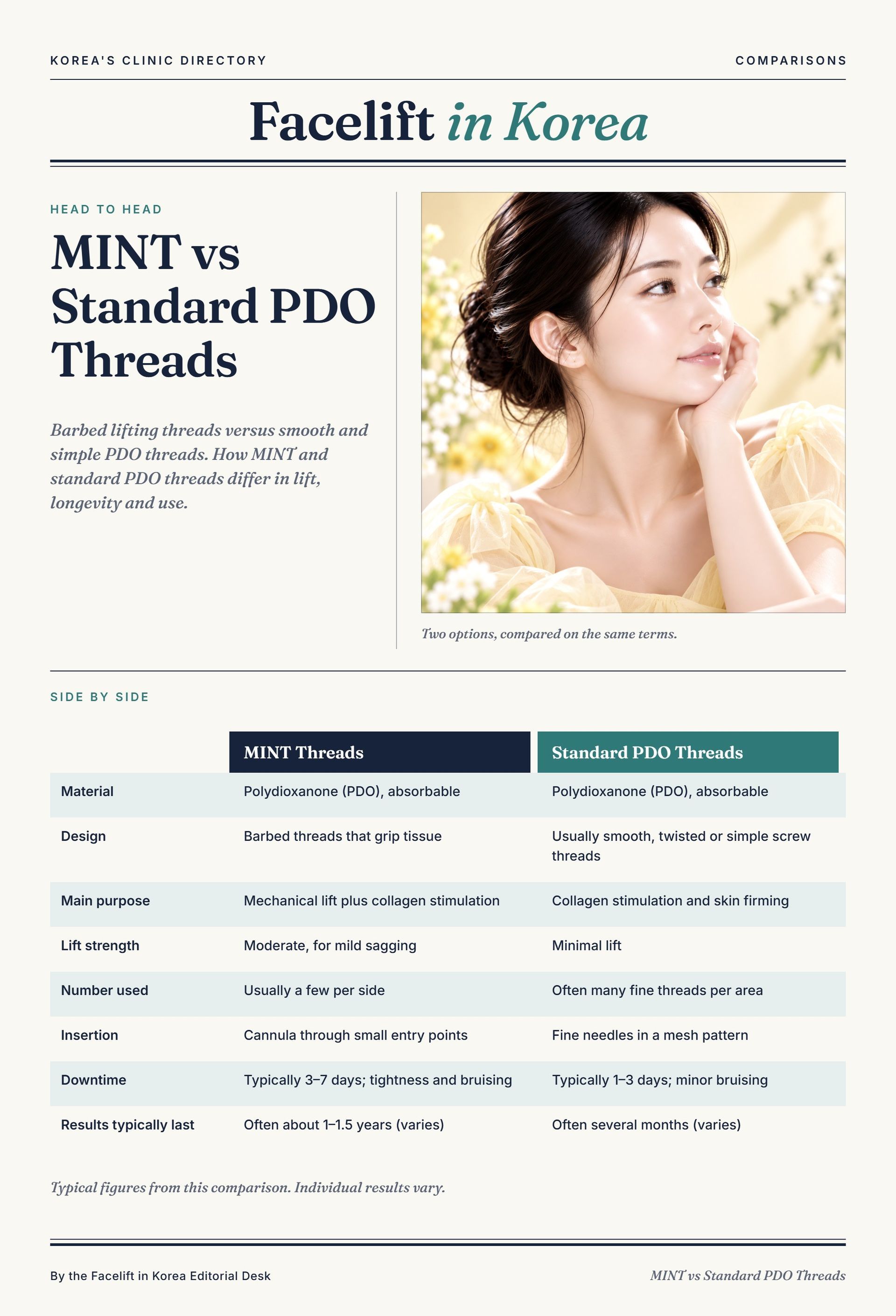
Quick answer: MINT is a Korean brand of barbed PDO lifting threads designed to grip and reposition sagging tissue. "Standard" PDO threads usually means smooth or simple twisted threads used mainly to stimulate collagen and improve skin quality, with little lift. Choose MINT or other barbed threads if you want a visible lift of mild jowls or cheeks. Choose smooth PDO threads if you want subtle skin firming.
Side by side

| MINT Threads | Standard PDO Threads | |
|---|---|---|
| Material | Polydioxanone (PDO), absorbable | Polydioxanone (PDO), absorbable |
| Design | Barbed threads that grip tissue | Usually smooth, twisted or simple screw threads |
| Main purpose | Mechanical lift plus collagen stimulation | Collagen stimulation and skin firming |
| Lift strength | Moderate, for mild sagging | Minimal lift |
| Number used | Usually a few per side | Often many fine threads per area |
| Insertion | Cannula through small entry points | Fine needles in a mesh pattern |
| Downtime | Typically 3–7 days; tightness and bruising | Typically 1–3 days; minor bruising |
| Results typically last | Often about 1–1.5 years (varies) | Often several months (varies) |
| Price guide | Thread lift cost in Korea | Thread lift cost in Korea |
What are PDO threads?
PDO stands for polydioxanone, an absorbable material long used in surgical sutures. In aesthetic medicine, PDO threads are placed under the skin, where they slowly dissolve over several months. As they dissolve, the body forms collagen around them. A PDO thread lift can use many different thread designs.
What are MINT threads?
MINT is a Korean brand of barbed PDO lifting threads. The threads have small barbs along their length that grip the tissue. After insertion through a cannula, the provider lifts the tissue and the barbs hold it in the new position. MINT threads are used for mild jowls, cheek descent, the jawline and sometimes the neck and brow.
What does "standard PDO threads" mean?
The term is used loosely. In many clinics, it refers to smooth "mono" threads or twisted "screw" threads. These have no barbs, so they do not lift tissue much. Instead, many fine threads are placed in a mesh pattern to stimulate collagen and improve firmness and texture. Some clinics also call their own barbed or cog threads "standard PDO", so always ask about the exact design.
Which is better for my concern?
- Mild sagging of cheeks, jowls or jawline: barbed threads such as MINT or other cog threads are usually chosen.
- Thin skin, fine lines or mild laxity without sagging: smooth or twisted PDO threads may be enough.
- Moderate to severe sagging: threads of any kind are unlikely to give a lasting result. See facelift vs thread lift.
What are the risks?
Barbed threads carry a slightly higher risk of dimpling, puckering, asymmetry or visible thread ends, because they grip tissue more strongly. Smooth threads mainly cause minor bruising. Both carry a small risk of infection or thread extrusion. Many early irregularities settle within a few weeks; persistent problems may need the thread removed.
What should I know about thread lifts in Korea?
Korea manufactures many thread brands, so Seoul clinics offer a wide range. Pricing is often per thread or per package, so a low headline price may include fewer threads than you need. Before booking, ask:
- Which brand and design will be used, and how many threads per side?
- Will the threads be barbed or smooth, and why is that design right for me?
- Who will perform the procedure, and how many thread lifts do they do?
- What should I avoid afterward, such as wide mouth opening, massage or dental work?
Thread lifts are usually done under local anesthesia in under an hour, so they fit easily into a short trip. Plan a few days before flying in case of swelling or bruising, and keep a record of the thread brand and number for future providers.
Can threads be combined with other treatments?
Yes. Threads are often combined with HIFU, RF or fillers for a more complete result. Ask about timing, as some providers prefer to perform energy treatments before thread placement. For a broader view of options, see surgical vs non-surgical facelift.
How do I know if threads are worth it for me?
Threads give the most satisfying results in people with mild sagging and good skin quality who accept a temporary effect. If you expect a dramatic or permanent change, surgery is usually a better fit. A good provider will say so honestly.
What is recovery like?
After a barbed thread lift, the face may feel tight and sore for several days, and small bruises or puckering near entry points are common. Most providers advise sleeping on your back, avoiding wide mouth opening, chewing hard foods, facial massage and strenuous exercise for one to two weeks. After smooth thread treatments, recovery is usually shorter, with minor bruising that fades in a few days. Contact the clinic promptly if you notice increasing pain, redness, warmth or a thread poking through the skin.
This page is general information, not medical advice. Decisions about surgery should be made with a qualified, board-certified plastic surgeon after an in-person examination.
Reader questions
Frequently asked questions
Are MINT threads better than PDO threads?
MINT threads are a type of PDO thread with barbs designed for lifting. They are better for mild sagging, while smooth PDO threads are better for subtle skin firming. The right choice depends on your concern.
How long do MINT threads last?
The threads dissolve over several months, and the lifting effect is often described as lasting about one to one and a half years. Results vary with skin, tissue weight and the number of threads.
Do smooth PDO threads lift the face?
Only minimally. Smooth threads mainly stimulate collagen to improve firmness and texture. For a visible lift, barbed threads are usually used.
Is a MINT thread lift painful?
It is usually done under local anesthesia, so most people feel pressure and pulling. Tightness and soreness for several days are common.
Can I fly after a thread lift in Korea?
Most people can fly within a few days. Many providers suggest staying at least two to three days so any early issues can be checked before you leave.
Next steps
Planning a facelift in Korea?
Compare clinics, check surgeon credentials and estimate your full trip budget before you book a consultation.
Facelift in Korea is an independent information directory. We do not perform procedures, and listings are not endorsements. This page is general information, not medical advice.