


Home › Comparisons › Fat Grafting vs Filler
Comparison
Fat Grafting vs Filler: Which Facial Volume Option Is Better?
By the Facelift in Korea Editorial Desk · Independent · How we report

The short answer
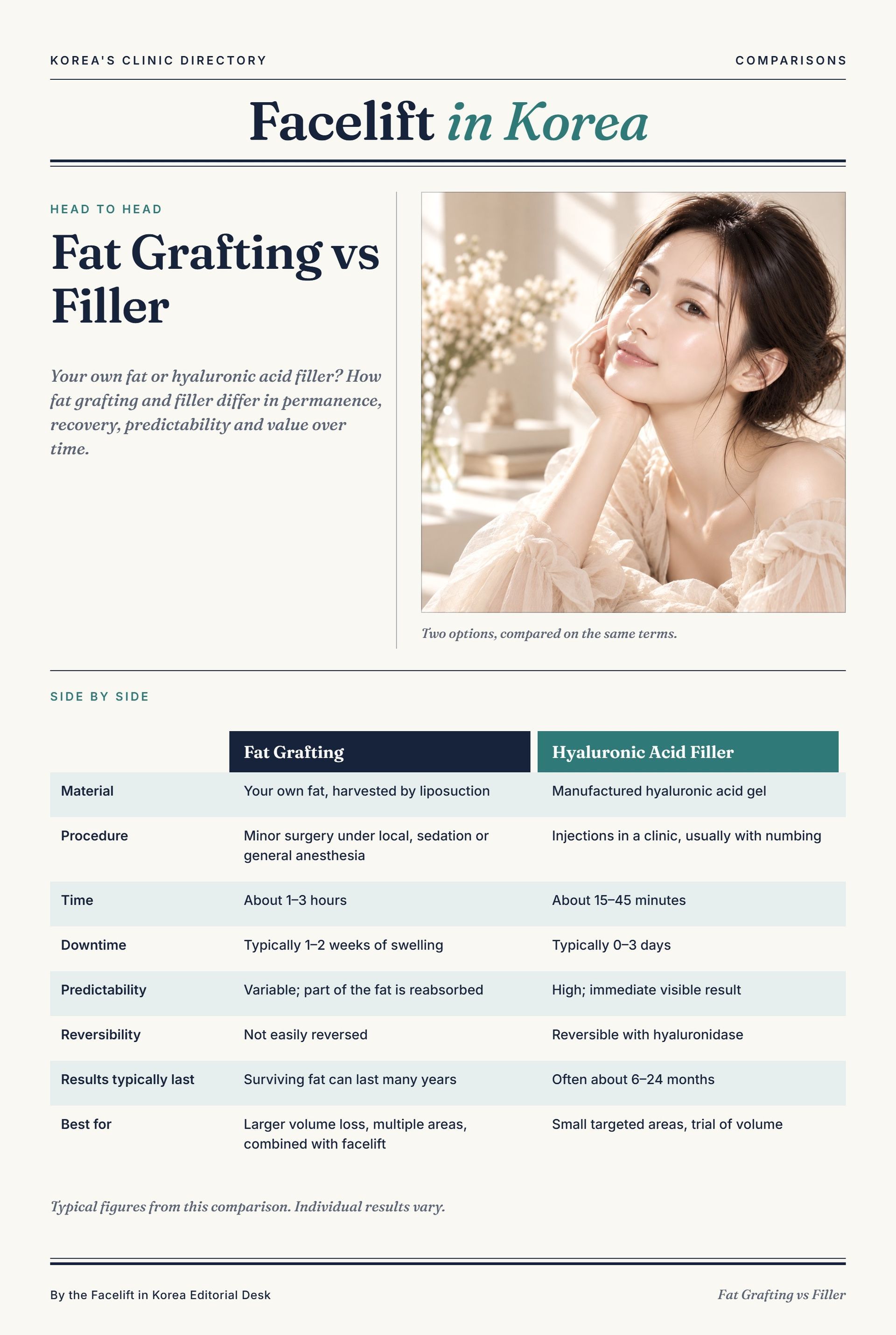
Quick answer: Fat grafting moves your own fat, usually from the abdomen or thighs, into areas of the face that have lost volume. Some of it survives long term. Filler, usually hyaluronic acid, gives an immediate, reversible result that lasts months to about two years. Choose fat grafting if you want larger-volume, longer-lasting restoration. Choose filler if you want a quick, adjustable result with almost no downtime.
Side by side

| Fat Grafting | Hyaluronic Acid Filler | |
|---|---|---|
| Material | Your own fat, harvested by liposuction | Manufactured hyaluronic acid gel |
| Procedure | Minor surgery under local, sedation or general anesthesia | Injections in a clinic, usually with numbing |
| Time | About 1–3 hours | About 15–45 minutes |
| Downtime | Typically 1–2 weeks of swelling | Typically 0–3 days |
| Predictability | Variable; part of the fat is reabsorbed | High; immediate visible result |
| Reversibility | Not easily reversed | Reversible with hyaluronidase |
| Results typically last | Surviving fat can last many years | Often about 6–24 months |
| Best for | Larger volume loss, multiple areas, combined with facelift | Small targeted areas, trial of volume |
| Price guide | Fat grafting cost in Korea | Non-surgical cost guide |
What is fat grafting?
Facial fat grafting, also called fat transfer, takes fat from another part of your body by gentle liposuction. The fat is processed and injected in small amounts into areas such as the temples, cheeks, under-eye hollows and jawline. A portion of the transferred fat establishes a blood supply and survives. The rest is reabsorbed over the first few months.
What is filler?
Filler usually means hyaluronic acid gel. It is injected to add volume, smooth folds and support tissue. Results are visible immediately, and hyaluronic acid can be dissolved with an enzyme called hyaluronidase if needed.
Which lasts longer?
Fat that survives can last many years and ages with you. Hyaluronic acid filler typically lasts from about six months to two years, depending on the product and area. However, fat survival varies, so some patients need a second fat grafting session to reach the desired volume.
Which is safer?
Both are generally safe in experienced hands, but both carry risks. Filler can cause swelling, bruising, lumps and, rarely, vascular occlusion, where filler blocks a blood vessel. Fat grafting can cause swelling, irregularities, cysts or overcorrection, and also carries a rare risk of vascular events. Fat grafting adds the small risks of liposuction and anesthesia. Choose a practitioner with detailed facial anatomy knowledge and ask how they would manage a complication.
Who should choose each?
- Fat grafting may suit you if you have significant volume loss, want several areas treated, are having a facelift anyway, or want a long-term result.
- Filler may suit you if you want a small, precise change, want to try volume first, or cannot take time off.
- Combination: some patients have fat grafting for broad volume and small amounts of filler for fine detail later.
How does fat grafting fit with a facelift?
Aging involves both sagging and volume loss. A facelift repositions tissue, but it does not restore lost volume. Many surgeons add fat grafting during a facelift to fill hollow temples, cheeks or the area under the eyes. See facelift vs fat grafting for more on how the two work together.
What should I know about fat grafting and filler in Korea?
Fat grafting is very popular in Seoul, where many clinics emphasize a soft, youthful facial contour. Some clinics offer enhanced techniques such as micro-fat, nano-fat or SVF-enriched fat. These may improve skin quality or graft survival, but evidence is still developing, so treat strong claims with caution.
International patients should plan around the swelling. Fat grafting usually needs about one to two weeks before you look socially comfortable. Ask how much fat will be grafted, which areas will be treated, and whether a touch-up session is included or charged separately. With filler, ask for the product name and confirm it is approved in Korea.
What is better value over time?
Fat grafting costs more at once but may last much longer. Filler costs less per session but needs repeating. For people with significant volume loss, fat grafting often becomes better value over several years. For small areas, filler may remain the simpler choice. Remember to include travel costs if you plan repeat visits to Korea, as covered in the total trip budget guide.
What is recovery like after each?
After filler, most people return to normal activities the same day, with mild swelling or small bruises for a few days. After fat grafting, the face is usually swollen for one to two weeks, and the donor area may feel bruised and sore. Surgeons often ask patients to avoid pressure on grafted areas and to sleep with the head raised. Final results from fat grafting are judged after about three to six months, once reabsorption has settled. The swelling and bruising guide has practical tips that also apply to fat grafting.
This page is general information, not medical advice. Decisions about surgery should be made with a qualified, board-certified plastic surgeon after an in-person examination.
Reader questions
Frequently asked questions
Is fat grafting permanent?
Fat that survives the first few months can last many years, but some of the transferred fat is always reabsorbed. Some patients need a second session, and the face continues to age.
Is fat grafting better than filler?
Neither is always better. Fat grafting suits larger volume loss and long-term goals, while filler suits small, precise changes and people who want little downtime.
How much fat survives after fat grafting?
Survival varies widely between patients and techniques. Surgeons often plan for some reabsorption and may suggest a touch-up after several months.
Can filler be removed if I do not like it?
Hyaluronic acid filler can usually be dissolved with hyaluronidase. Fat grafting cannot be reversed as easily.
How long is recovery after facial fat grafting in Korea?
Most patients have visible swelling for about one to two weeks. Plan to stay in Seoul for at least several days for follow-up before flying.
Next steps
Planning a facelift in Korea?
Compare clinics, check surgeon credentials and estimate your full trip budget before you book a consultation.
Facelift in Korea is an independent information directory. We do not perform procedures, and listings are not endorsements. This page is general information, not medical advice.