


Home › Comparisons › Vertical vs Deep Plane Facelift
Comparison
Vertical vs Deep Plane Facelift: Lift Direction and Depth Compared
By the Facelift in Korea Editorial Desk · Independent · How we report

The short answer
Quick answer: "Vertical facelift" describes the direction of lift: tissue is moved mostly upward rather than backward toward the ear. "Deep plane facelift" describes the depth: tissue is released below the SMAS and lifted as one unit. The two can overlap, since many deep plane lifts are performed vertically. Choose vertical if you want to avoid a pulled look. Choose deep plane if you need strong midface and jowl correction.
Side by side

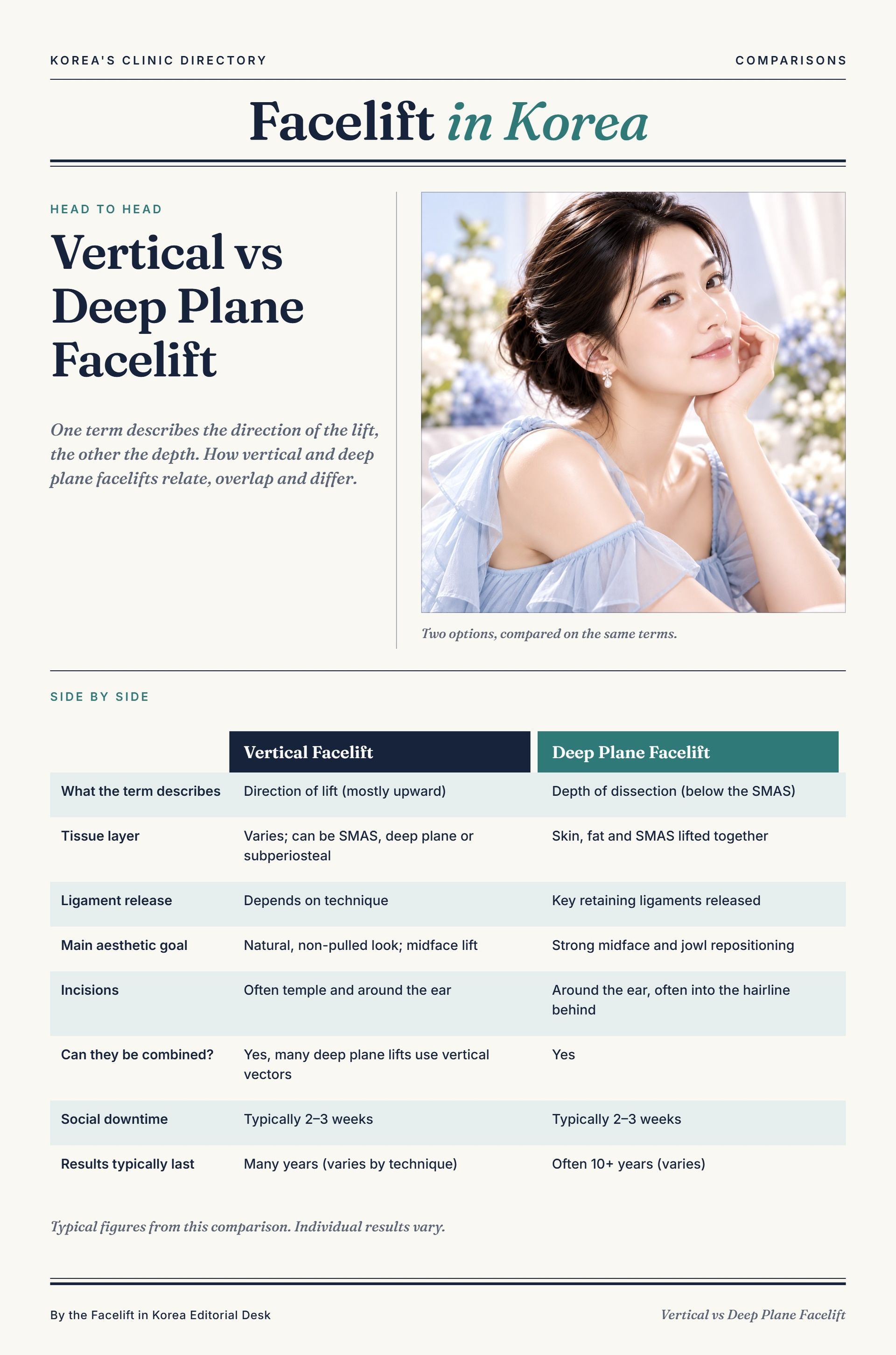
| Vertical Facelift | Deep Plane Facelift | |
|---|---|---|
| What the term describes | Direction of lift (mostly upward) | Depth of dissection (below the SMAS) |
| Tissue layer | Varies; can be SMAS, deep plane or subperiosteal | Skin, fat and SMAS lifted together |
| Ligament release | Depends on technique | Key retaining ligaments released |
| Main aesthetic goal | Natural, non-pulled look; midface lift | Strong midface and jowl repositioning |
| Incisions | Often temple and around the ear | Around the ear, often into the hairline behind |
| Can they be combined? | Yes, many deep plane lifts use vertical vectors | Yes |
| Social downtime | Typically 2–3 weeks | Typically 2–3 weeks |
| Results typically last | Many years (varies by technique) | Often 10+ years (varies) |
| Price guide | Facelift cost overview | Deep plane cost in Korea |
Why are these terms confusing?
Facelift names often mix different ideas. Some names describe the depth of the lift, such as skin-only, SMAS or deep plane. Others describe the direction of the lift, such as vertical or lateral. Others describe the incision, such as short-scar. A "vertical deep plane facelift" is therefore a real and common combination, not a contradiction.
What is a vertical facelift?
A vertical facelift repositions sagging tissue mostly upward, the way it descended with age. Older facelift methods often pulled tissue backward toward the ear, which could flatten the cheek and create a "windswept" look. A vertical vector aims to restore the cheek and lift the jowls while keeping a natural expression. The technique used underneath can vary: some vertical lifts work at the SMAS level, others in the deep plane or under the periosteum (the lining of the bone).
What is a deep plane facelift?
A deep plane facelift enters the space below the SMAS and releases the retaining ligaments that tether the cheek and jaw. Skin, fat and SMAS are then lifted together. Because the tissues move as one unit, there is less tension on the skin, and the midface can be lifted significantly. Many deep plane surgeons deliberately use a vertical or oblique vector.
Which is right for me?
- Ask about both depth and direction. A good plan specifies which layer will be lifted and in which direction.
- Heavy midface and jowls: a deep plane approach with a vertical vector is often recommended.
- Mild to moderate laxity: a vertical SMAS lift or limited-incision technique may be enough.
- Concern about a "pulled" look: a vertical vector is designed to avoid this, regardless of depth.
Are the risks different?
Risks depend more on depth and surgeon experience than on direction. Deeper dissection works closer to branches of the facial nerve, so it requires precise anatomical knowledge. All facelifts carry risks of hematoma, infection, scarring, numbness and asymmetry. See facelift risks and complications.
How are these lifts described in Seoul?
Korean clinics often use descriptive or branded names for facelifts, and "vertical" and "deep plane" are both common in Seoul marketing. East Asian faces frequently have a broader midface and heavier soft tissue, so many Korean surgeons emphasize vertical midface lifting to avoid widening the face. That is one reason vertical approaches are popular in Korea.
International patients should ask the surgeon to explain the plan in plain terms: which layer, which ligaments, which direction and where the incisions go. The guide on the natural Korean facelift aesthetic explains the look many Seoul surgeons aim for.
What is recovery like?
Recovery is broadly similar to other comprehensive facelifts. Expect swelling and bruising for about two weeks, tightness for several weeks, and gradual refinement over three to six months. Vertical lifts that include the midface may cause more swelling around the eyes and cheeks at first. Plan about ten to fourteen days in Seoul before flying home.
What should I ask at my consultation?
- Which tissue layer will you lift, and which ligaments will you release?
- What direction will the lift take, and why for my face?
- How will the incisions be placed, and will they go behind the ear?
- Will my cheeks look fuller or flatter afterward?
- Do I also need fat grafting or a neck procedure for balance?
How do I compare quotes that use different names?
Two clinics may describe similar operations with different names, or use the same name for very different operations. To compare fairly, ask each clinic to write down the tissue layer, the direction of lift, the incision path, any added procedures such as fat grafting or neck work, and the anesthesia type. Then compare what is actually included, not the label. The guide to why prices vary explains other factors that affect quotes.
This page is general information, not medical advice. Decisions about surgery should be made with a qualified, board-certified plastic surgeon after an in-person examination.
Reader questions
Frequently asked questions
Is a vertical facelift the same as a deep plane facelift?
No. Vertical describes the direction of the lift, while deep plane describes the depth. A facelift can be both vertical and deep plane at the same time.
Does a vertical facelift look more natural?
Many surgeons believe a mainly vertical lift avoids the windswept look of older backward-pulling techniques. Results still depend on the surgeon and your anatomy.
Which lasts longer, vertical or deep plane?
Longevity depends mostly on the depth of the lift, your tissue and lifestyle. Deep plane lifts are often described as long lasting, but individual results vary.
Is a vertical facelift good for Asian faces?
Many Korean surgeons favor vertical lifting for East Asian faces because it can lift the midface without widening the face. A surgeon should assess your individual anatomy.
What should I ask about facelift names?
Ask which tissue layer will be lifted, which ligaments will be released, what direction the lift will take and where the incisions will be.
Next steps
Planning a facelift in Korea?
Compare clinics, check surgeon credentials and estimate your full trip budget before you book a consultation.
Facelift in Korea is an independent information directory. We do not perform procedures, and listings are not endorsements. This page is general information, not medical advice.