


Home › Comparisons › MACS vs Short-Scar Facelift
Comparison
MACS vs Short-Scar Facelift: How These Limited-Incision Lifts Compare
By the Facelift in Korea Editorial Desk · Independent · How we report
The short answer
Quick answer: A MACS lift is a specific short-scar facelift that uses purse-string sutures to lift the SMAS vertically, with an incision in front of the ear only. "Short-scar facelift" is a broader term for any facelift that avoids the long incision behind the ear. Choose a MACS lift if you have early jowling and mild neck laxity. Choose another short-scar method if your surgeon advises it for your face.
Side by side
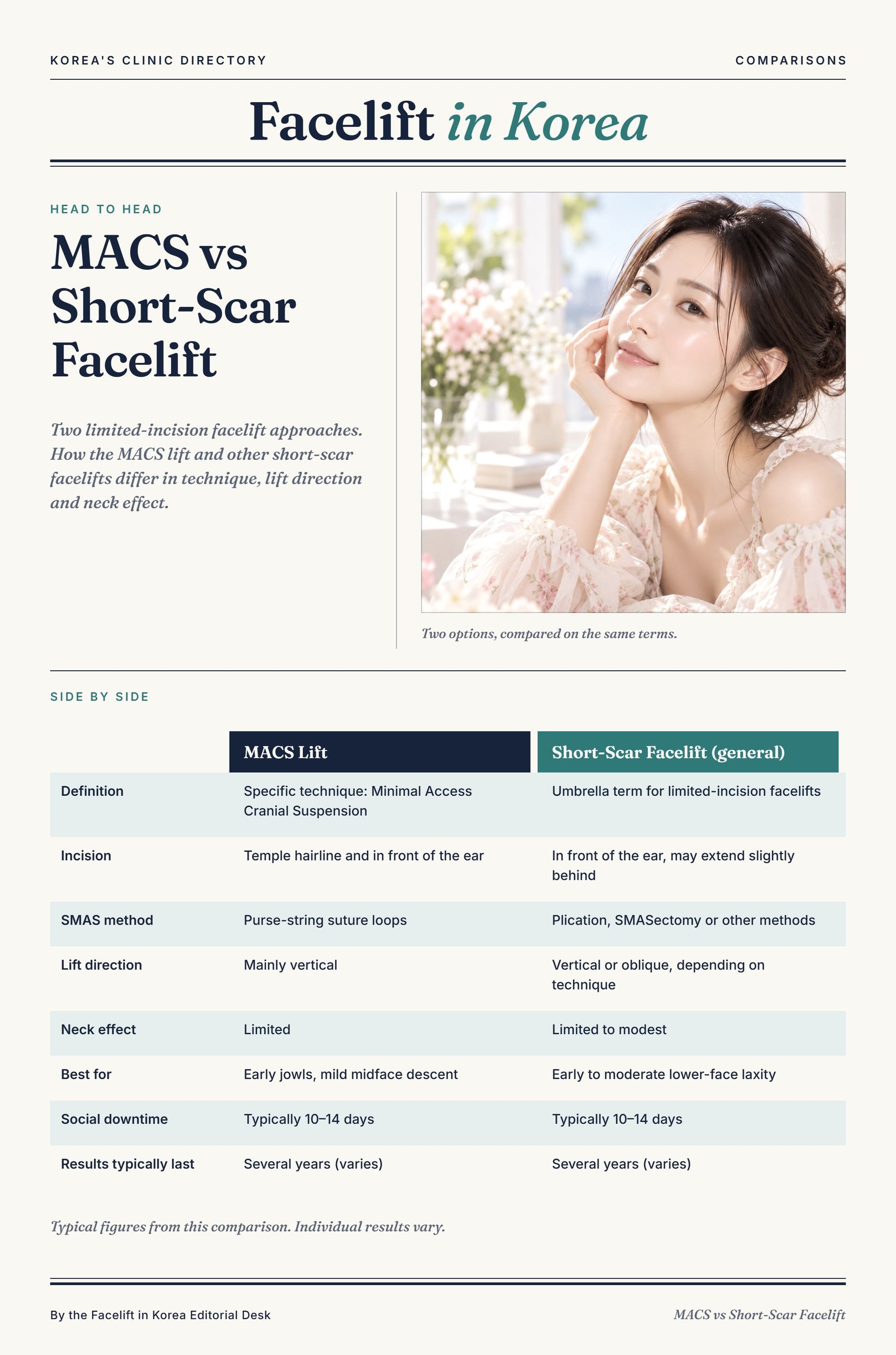
| MACS Lift | Short-Scar Facelift (general) | |
|---|---|---|
| Definition | Specific technique: Minimal Access Cranial Suspension | Umbrella term for limited-incision facelifts |
| Incision | Temple hairline and in front of the ear | In front of the ear, may extend slightly behind |
| SMAS method | Purse-string suture loops | Plication, SMASectomy or other methods |
| Lift direction | Mainly vertical | Vertical or oblique, depending on technique |
| Neck effect | Limited | Limited to modest |
| Best for | Early jowls, mild midface descent | Early to moderate lower-face laxity |
| Social downtime | Typically 10–14 days | Typically 10–14 days |
| Results typically last | Several years (varies) | Several years (varies) |
| Price guide | Mini facelift cost in Korea | Mini facelift cost in Korea |
What is a MACS lift?
MACS stands for Minimal Access Cranial Suspension. In a MACS facelift, the surgeon makes an incision along the temple hairline and in front of the ear. After lifting a limited area of skin, the surgeon places strong purse-string sutures in the SMAS layer and anchors them to firm tissue near the temple. Tightening these loops lifts the jowls and lower cheek in a mainly vertical direction. An extended version adds a third loop to lift the midface.
What is a short-scar facelift?
A short-scar facelift is any facelift that uses a shorter incision than a traditional facelift, usually avoiding the long incision behind the ear and into the hairline. The SMAS may be tightened by folding (plication), by removing a strip (SMASectomy), or by other methods. The MACS lift is one type of short-scar facelift. So are many procedures marketed as a mini facelift or S-lift.
How do they differ?
- Specific vs general: MACS is a defined technique. "Short-scar" can mean many things, so ask exactly what will be done.
- Suspension method: MACS uses purse-string sutures. Other short-scar methods may cut or fold the SMAS.
- Direction: MACS lifts mainly vertically, which some surgeons feel gives a more natural, less "pulled" result.
- Neck: both have limited effect on loose neck skin, because they do not extend far enough behind the ear.
Who is a good candidate?
Both suit people with early to moderate jowling, mild cheek descent, good skin elasticity and minimal neck laxity. People with significant neck laxity or very loose skin usually do better with a full facelift or a face and neck lift. See mini facelift vs full facelift for more on this choice.
What are the risks?
Both share the usual facelift risks: bleeding, hematoma, infection, scarring, numbness and, rarely, facial nerve injury. With short-scar techniques, there can be skin bunching near the earlobe, which usually settles over weeks. Some patients need a touch-up if early relapse occurs. Read more in facelift risks and complications.
What should I know about short-scar facelifts in Korea?
Short-scar facelifts are popular with international visitors to Seoul because of the shorter incision and somewhat faster recovery. Some Korean clinics name their limited-incision procedures with their own brand terms. International patients should not rely on the name alone. Ask:
- Which SMAS technique will be used: purse-string, plication, SMASectomy or deep plane?
- Where exactly will the incision run, and will it go behind the ear?
- What will happen to my neck, and will I need a separate neck procedure?
- How many of these procedures does the surgeon perform each month?
Asian skin can be more prone to visible or thickened scars, so incision placement and scar care matter. See facelift scarring and Asian skin.
What is recovery like?
Most patients have moderate swelling and bruising for about one to two weeks. Stitches are typically removed around five to seven days after surgery. Many people feel comfortable in public after ten to fourteen days. Plan to stay in Seoul for about seven to ten days for follow-up before flying home.
How long do results last?
Results typically last several years. Because the operation is less extensive, some surgeons expect a somewhat shorter duration than a full facelift, especially in patients with heavier tissue. Aging continues after any facelift, so a later procedure may be considered.
What should I ask at my consultation?
- Is a limited-incision facelift enough for my degree of laxity?
- Which SMAS method will you use, and why that one for me?
- How will my neck look after surgery, and should I consider a neck lift too?
- Where will the incision sit relative to my hairline and ear?
- What is your approach if I need a touch-up later?
Bring photos from the front and both sides, with your hair pulled back, so the surgeon can assess the jawline and neck clearly.
This page is general information, not medical advice. Decisions about surgery should be made with a qualified, board-certified plastic surgeon after an in-person examination.
Reader questions
Frequently asked questions
Is a MACS lift the same as a mini facelift?
A MACS lift is one specific type of limited-incision facelift. "Mini facelift" is a broader marketing term that can describe several techniques, including MACS.
Does a MACS lift tighten the neck?
Only slightly. Because there is no long incision behind the ear, loose neck skin cannot be fully redraped. A separate neck lift may be needed.
How long does a MACS facelift last?
Results typically last several years. Longevity depends on age, skin quality, tissue weight and lifestyle.
What is the scar like after a short-scar facelift?
The scar usually runs along the temple hairline and in front of the ear. It is designed to follow natural creases and typically fades over six to twelve months.
Is a short-scar facelift a good option in Korea?
It can be, especially for patients with early laxity and limited time. Ask exactly which technique will be used, since names vary between clinics.
Next steps
Planning a facelift in Korea?
Compare clinics, check surgeon credentials and estimate your full trip budget before you book a consultation.
Facelift in Korea is an independent information directory. We do not perform procedures, and listings are not endorsements. This page is general information, not medical advice.