


Home › Comparisons › Sculptra vs Juvelook
Comparison
Sculptra vs Juvelook: Comparing Collagen-Stimulating Injectables
By the Facelift in Korea Editorial Desk · Independent · How we report
The short answer
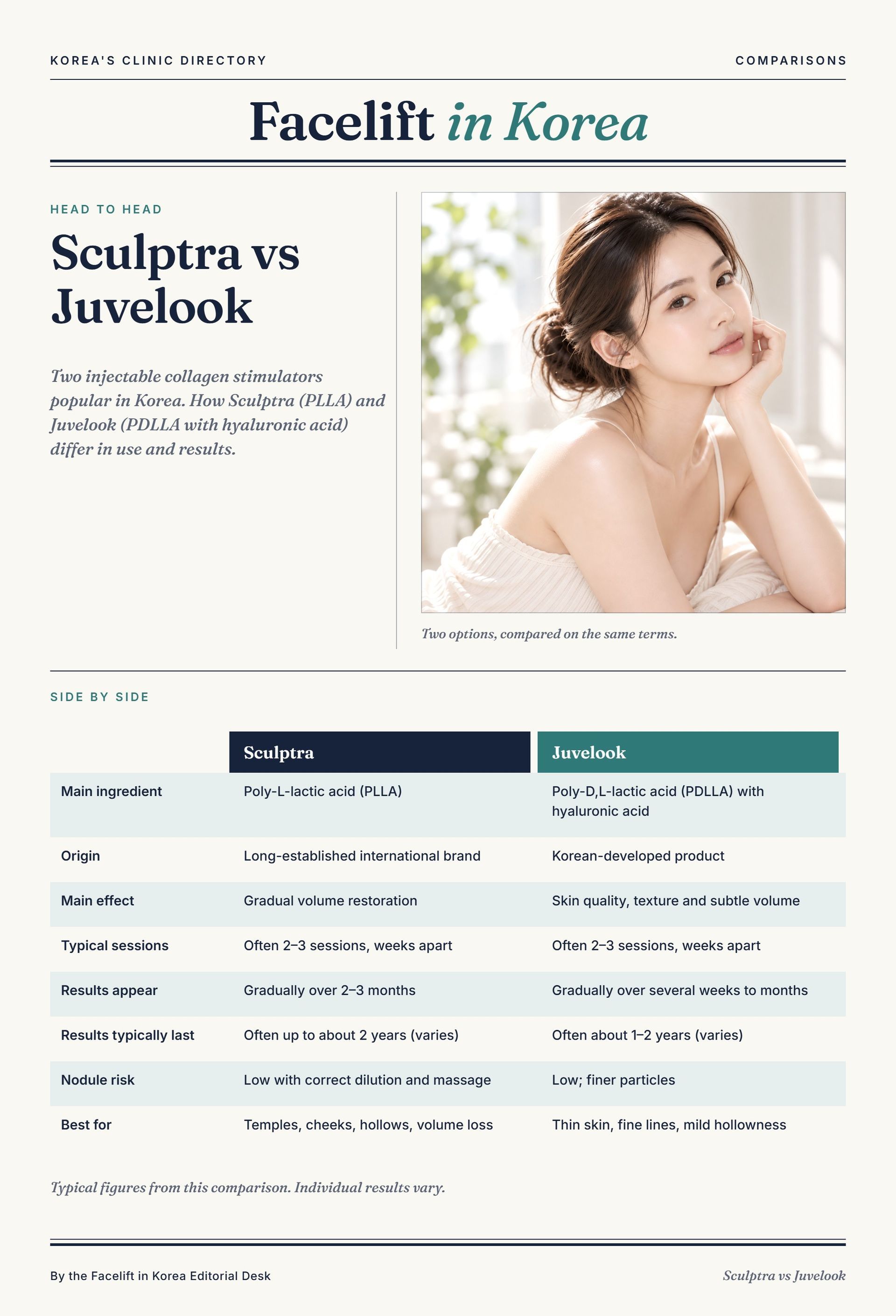
Quick answer: Sculptra uses poly-L-lactic acid (PLLA) to stimulate collagen gradually and restore volume over a series of sessions. Juvelook is a Korean product combining PDLLA and hyaluronic acid, often used for finer skin-quality improvement and softer volume. Choose Sculptra if you want gradual volume restoration for hollow areas. Choose Juvelook if you mainly want firmer, smoother skin with subtle volume.
Side by side

| Sculptra | Juvelook | |
|---|---|---|
| Main ingredient | Poly-L-lactic acid (PLLA) | Poly-D,L-lactic acid (PDLLA) with hyaluronic acid |
| Origin | Long-established international brand | Korean-developed product |
| Main effect | Gradual volume restoration | Skin quality, texture and subtle volume |
| Typical sessions | Often 2–3 sessions, weeks apart | Often 2–3 sessions, weeks apart |
| Results appear | Gradually over 2–3 months | Gradually over several weeks to months |
| Results typically last | Often up to about 2 years (varies) | Often about 1–2 years (varies) |
| Nodule risk | Low with correct dilution and massage | Low; finer particles |
| Best for | Temples, cheeks, hollows, volume loss | Thin skin, fine lines, mild hollowness |
| Price guide | Non-surgical lifting cost | Non-surgical lifting cost |
What is Sculptra?
Sculptra is an injectable made of poly-L-lactic acid (PLLA), a biocompatible material that the body gradually breaks down. Rather than filling an area immediately like hyaluronic acid filler, Sculptra stimulates the body to produce its own collagen over several months. It is commonly used to restore volume in the temples, cheeks and other areas affected by age-related volume loss.
What is Juvelook?
Juvelook is a Korean-developed injectable that combines PDLLA (poly-D,L-lactic acid) with hyaluronic acid. The hyaluronic acid gives some early hydration and smoothness, while the PDLLA stimulates collagen over time. Juvelook is popular in Seoul for improving skin texture, fine lines, enlarged pores and mild hollowness. A thicker "volume" version is offered by some clinics for areas that need more support.
How do they differ?
- Purpose: Sculptra is mainly used for volume restoration. Juvelook is often used for skin quality with subtle volume.
- Feel: Juvelook's hyaluronic acid gives a smoother early result. Sculptra's early fullness from the water carrier fades within days, and the real result builds slowly.
- Injection technique: Sculptra is injected deeper for structural volume. Juvelook is often injected more superficially for skin quality.
Which should I choose?
If your main concern is facial volume loss, such as hollow temples or flat cheeks, Sculptra is often the first choice. If your concern is thin, crepey or dull skin with only mild hollowing, Juvelook may be a better fit. Some patients use both in different areas. For sagging that comes from tissue descent rather than volume loss, collagen stimulators help little; lifting treatments or surgery are more appropriate.
What are the risks?
Common side effects of both include swelling, bruising and tenderness for a few days. The main specific risk is small lumps or nodules under the skin. With correct dilution, depth and post-treatment massage, this risk is generally low. As with any injectable, there is a rare risk of vascular complications, so choose an experienced medical injector.
What should international patients know about these treatments in Korea?
Juvelook is widely available in Seoul and often cheaper than imported products. Sculptra is also available but is typically priced higher. Because both need two or three sessions spaced several weeks apart, a single short trip may not be enough for a full course. Some patients start in Korea and continue at home, but Juvelook may not be available in every country.
Before booking, ask how many vials will be used, how the product will be diluted, how many sessions you will need, and whether you will be given massage instructions. See the fat grafting vs filler comparison if you are weighing other ways to restore volume.
How do they compare with hyaluronic acid filler?
Hyaluronic acid filler gives an immediate, reversible result in a specific spot. Collagen stimulators give a gradual, more diffuse result and cannot be dissolved. Many patients like collagen stimulators because the result looks natural and builds slowly. Others prefer the immediate, adjustable effect of filler.
Who is not a good candidate?
Collagen stimulators are generally avoided in pregnancy, in areas with active skin infection, and in people with a history of keloids or certain autoimmune conditions. Tell your provider about all previous fillers and treatments, including the product names and dates if you know them.
What is the treatment process like?
Both products are reconstituted or prepared shortly before injection. The provider cleanses the skin, may apply numbing cream, and injects with a needle or cannula. A session usually takes thirty to sixty minutes. Swelling and small bruises may last a few days. With Sculptra, many providers ask patients to massage the area several times a day for a few days to help even distribution. Because the result develops slowly, it is important to wait the recommended interval before deciding whether more product is needed.
This page is general information, not medical advice. Decisions about surgery should be made with a qualified, board-certified plastic surgeon after an in-person examination.
Reader questions
Frequently asked questions
Is Juvelook the same as Sculptra?
No. Sculptra contains PLLA, while Juvelook contains PDLLA combined with hyaluronic acid. Both stimulate collagen, but Sculptra is mainly used for volume and Juvelook is often used for skin quality.
How many sessions of Sculptra or Juvelook do I need?
Most people need two to three sessions, usually several weeks apart. The exact number depends on the area and degree of volume loss.
How long do Sculptra and Juvelook last?
Sculptra results often last up to about two years, and Juvelook results often last about one to two years. Individual results vary.
Can collagen stimulators cause lumps?
Small nodules are a known risk, but they are uncommon when the product is diluted and injected correctly and post-treatment massage instructions are followed.
Can I get Juvelook outside Korea?
Availability varies by country. If you plan to continue treatment at home, check whether Juvelook is approved and available there.
Next steps
Planning a facelift in Korea?
Compare clinics, check surgeon credentials and estimate your full trip budget before you book a consultation.
Facelift in Korea is an independent information directory. We do not perform procedures, and listings are not endorsements. This page is general information, not medical advice.