


The short answer
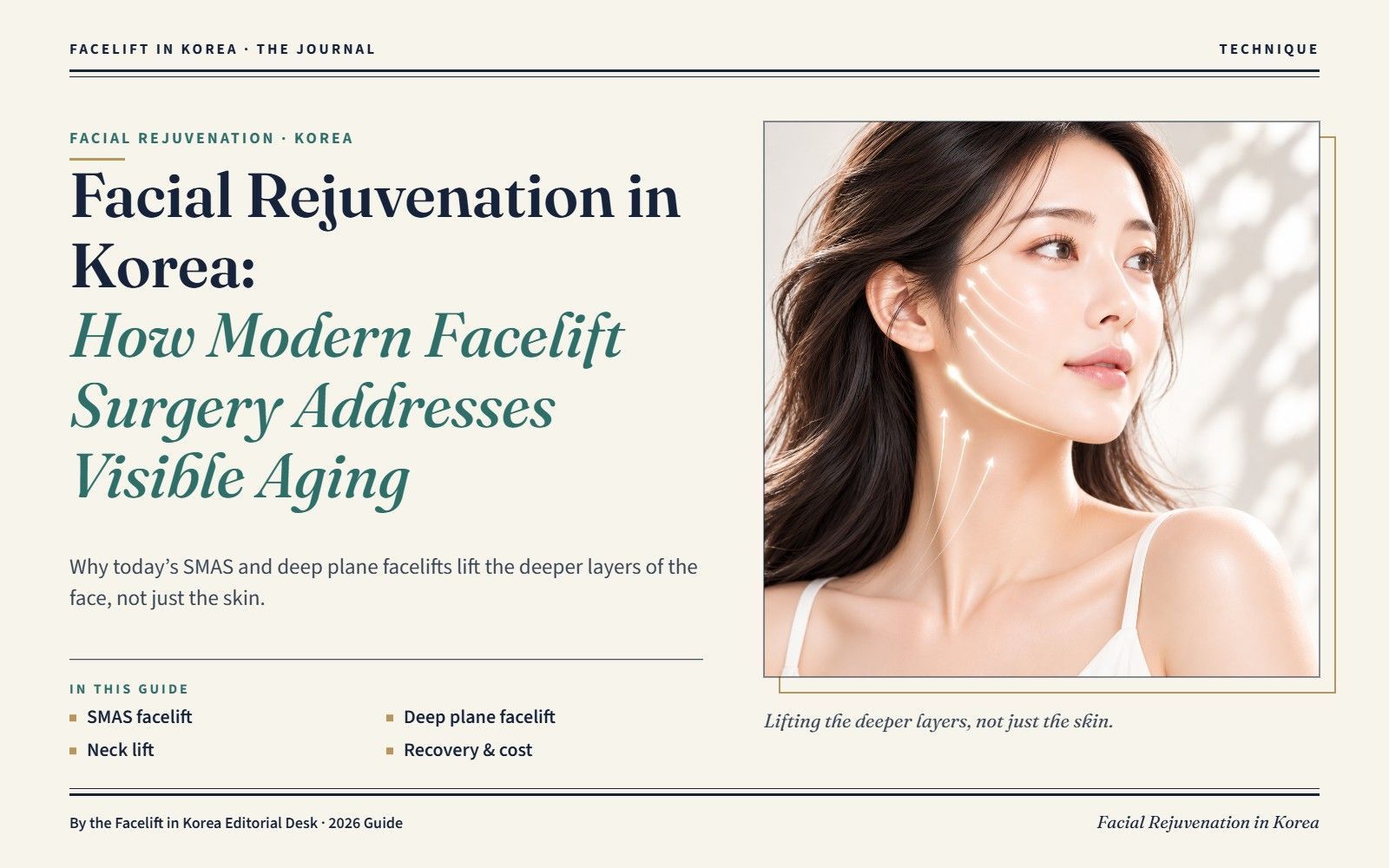
A modern facelift treats visible ageing by repositioning the deeper support layers of the face, not just tightening the skin. Techniques such as the SMAS facelift and the deep plane facelift lift sagging cheeks, jowls and neck tissue back toward their original position, then remove only the excess skin. In Korea, these procedures are performed by board-certified plastic surgeons, mostly in Seoul, with an indicative 2026 cost of about ₩7M–15M (roughly US$5,300–11,300) for a primary SMAS facelift. Most surgeons ask overseas patients to stay 10–14 days.
Key takeaways
- Facial ageing happens in five layers: skin, fat, the SMAS muscle layer, retaining ligaments and bone.
- Sagging jowls, deep nasolabial folds and a loose neck come from the deeper layers, which is why skin-only lifts rarely last.
- SMAS and deep plane facelifts are the main surgical options; a neck lift or fat grafting is often combined.
- Non-surgical lifting (HIFU, radiofrequency, threads) can help mild laxity but cannot reposition significant sagging.
- Results depend on the individual surgeon, not the country. Verify board certification before you book.
What happens to the face as it ages?
Visible ageing is not just "loose skin". From the late 30s onward, several layers change at the same time. Understanding this helps you judge whether a clinic's recommendation actually fits your face.
| Layer | What changes | What you see in the mirror |
|---|---|---|
| Skin | Less collagen and elastin, thinner dermis | Fine lines, crepey texture, dullness |
| Fat pads | Cheek fat descends and some areas lose volume | Flatter cheeks, hollow under-eyes, deeper nasolabial folds |
| SMAS(superficial musculo-aponeurotic system) | The supportive muscle-fascia layer stretches and drops | Jowls, a blurred jawline, heaviness in the lower face |
| Retaining ligaments | The "anchors" between skin and bone weaken | Marionette lines, a sad or tired resting expression |
| Bone | Gradual resorption around the eye sockets and jaw | Less facial projection, looser soft tissue on top |
A facelift mainly addresses the middle three layers. Skin quality and bone changes are usually treated separately, with energy-based skin treatments or volume restoration.
How modern facelift surgery addresses each sign
Older facelift methods pulled the skin tight, which could create a "windswept" look and tended to relax within a few years. Contemporary techniques lift the deeper tissue vertically and let the skin sit naturally on top. The main approaches you will see in Seoul are below.
SMAS facelift
The surgeon tightens or folds (plicates) the SMAS layer, then trims excess skin. It is the most widely performed facelift and suits moderate jowling and lower-face laxity. See our SMAS facelift cost guide for current price ranges.
Deep plane facelift
The surgeon works beneath the SMAS and releases key retaining ligaments, so the cheek, jowl and neck tissue move as one unit. It is often chosen for more advanced mid-face and jowl sagging and is designed to give a natural, longer-lasting result, though it is technically more demanding. Read our side-by-side comparison: Deep plane vs SMAS facelift.
Mini or short-scar facelift
A shorter incision and a more limited lift for early jowling in younger patients. Recovery is quicker, but it cannot correct significant neck laxity.
Neck lift and combination procedures
Many patients combine a facelift with a neck lift (platysma tightening), upper or lower eyelid surgery, or fat grafting to restore lost volume. Combining procedures can mean one anaesthetic and one recovery period, but it also adds operating time, so discuss the trade-off with your surgeon.
| Technique | Best suited to | Incision | Typical social downtime* |
|---|---|---|---|
| SMAS facelift | Moderate jowls, lower-face laxity | Around the ear, into the hairline | About 2 weeks |
| Deep plane facelift | Mid-face descent, deeper folds, jowls and neck | Around the ear, into the hairline | About 2–3 weeks |
| Mini facelift | Early jowling, minimal neck change | Shorter, in front of the ear | About 7–10 days |
| Neck lift | Neck bands, loose skin under the chin | Under the chin and/or behind the ear | About 2 weeks |
*Indicative only. Swelling and bruising vary by person, technique and combined procedures. Final results usually settle over 3–6 months.
Facelift considerations for East Asian faces
Korean surgeons treat a high volume of East Asian patients, and many international patients from Asia choose Seoul for that reason. Surgeons often take into account a wider mid-face, fuller soft tissue over the cheeks and a higher tendency toward scar pigmentation in some skin types. In practice this can influence incision placement around the ear and hairline, how much tissue is lifted versus repositioned, and the scar-care plan after surgery. Patients of every ethnicity should ask to see before-and-after photos of faces similar to their own.
Facelift vs non-surgical lifting: what each can do
Korea is also known for non-surgical lifting such as HIFU, radiofrequency microneedling and thread lifts. These can tighten skin and slightly improve contour in mild cases, with little downtime. However, they cannot reposition descended fat or release ligaments, so for established jowls or neck laxity a surgical facelift usually gives a more meaningful and durable result. Explore the options in our non-surgical lifting guide.
Who is a good candidate?
- Visible jowls, deep nasolabial or marionette lines, or loose neck skin
- Generally good health, with conditions such as high blood pressure or diabetes well controlled
- Non-smoker, or willing to stop for several weeks before and after surgery (ask your surgeon for their exact rule)
- Realistic expectations: a refreshed version of yourself, not a different face
- Able to stay in Korea long enough for check-ups and stitch removal
The patient journey in Seoul, step by step
- Online consultation. Send clear photos (front, both sides, 45°) and your medical history. Many Seoul clinics offer consultations in English, and some in Chinese or Japanese.
- In-person consultation and tests. On arrival, you meet the operating surgeon, confirm the plan and complete pre-operative tests.
- Surgery day. Most facelifts take several hours under general anaesthesia or sedation. Some patients stay overnight.
- First week. Swelling and bruising peak in the first few days. Drains (if used) and some stitches are removed during follow-up visits.
- Days 10–14. Final check-up and fit-to-fly confirmation. See how long to stay in Korea after a facelift.
- Back home. Continue scar care and remote follow-ups. Most swelling fades over several weeks, with final results at 3–6 months.
For a detailed timeline, read Facelift recovery, one day at a time.
Safety and the rules that protect patients in Korea
- Board certification: check that your surgeon is a board-certified plastic surgeon. Our guide explains how to verify a plastic surgeon in Korea.
- CCTV in the operating room: since September 2023, clinics must record surgery performed under general anaesthesia if the patient requests it.
- Ghost surgery: confirm in writing who will perform your operation. Learn more about ghost surgery and the laws against it.
- Tax: Korea's VAT refund for foreign cosmetic surgery patients ended on December 31, 2025, so do not budget for it. Details here.
- Risks: every facelift carries risks such as haematoma, nerve injury, infection and scarring. Read facelift risks and complications before deciding.
Questions to ask at your consultation
- Which technique do you recommend for my face, and why?
- Will you personally perform the entire operation?
- What type of anaesthesia is used, and who administers it?
- What exactly is included in the quoted price (tests, medication, follow-ups, revision policy)?
- How many days should I stay in Seoul, and how will follow-up work after I fly home?
- Can I see before-and-after photos of patients with a similar face and age?
Frequently asked questions
How much does a facelift cost in Korea in 2026?
An indicative range for a primary SMAS facelift in Seoul is about ₩7M–15M (roughly US$5,300–11,300). Deep plane and combined procedures are usually priced higher. Prices vary by surgeon and clinic, so always confirm what the quote includes. See our facelift cost guide.
How long does a facelift last?
A well-performed facelift that repositions the deeper layers typically keeps you looking younger than you otherwise would for many years. Ageing continues, however, and skin quality, genetics, sun exposure and smoking all affect how long results last.
What is the best age for a facelift?
There is no single best age. Most patients are in their 40s to 60s, but the decision depends on how much laxity you have, your skin quality and your goals rather than the number on your passport.
Will people be able to tell I had a facelift?
Modern techniques aim for a natural, rested look. Incisions are placed around the ear and in the hairline, and usually fade over several months. Choosing an experienced surgeon is the most important factor in a natural result.
Is a deep plane facelift better than a SMAS facelift?
Neither is better for everyone. A deep plane facelift can be well suited to more advanced mid-face and jowl sagging, while a SMAS facelift is effective for many patients with moderate laxity. The right choice depends on your anatomy and your surgeon's expertise.
Do I need a visa or K-ETA to have surgery in Korea?
It depends on your nationality and length of stay. Some travellers are temporarily exempt from K-ETA, while others need a medical tourism visa for longer stays. Check our K-ETA guide for medical tourists and confirm with official sources before booking flights.
This article is for general information only and is not medical advice. Facelift in Korea is an independent guide: we do not perform surgery, take bookings or accept paid rankings. Figures are indicative as of October 2026; always confirm prices, eligibility and risks directly with a qualified, board-certified surgeon.









