


Home › Non-Surgical Lifting › APTOS Thread Lift
Non-Surgical Lifting
APTOS Thread Lift in Seoul, Korea: What to Know Before Booking
By the Facelift in Korea Editorial Desk · Independent · How we report

The short answer
Quick answer: APTOS is a range of lifting threads made by Aptos LLC in Tbilisi, Georgia, whose founders helped pioneer barbed thread lifting. The range includes absorbable threads and permanent polypropylene sutures. They are used to lift the midface, jowls, brow and neck. Recovery usually takes one to two weeks. Longevity depends heavily on the thread type and technique.

What is the APTOS thread lift?
APTOS is a brand of lifting threads made by Aptos LLC, a company based in Tbilisi, Georgia. Its founders, the Sulamanidze family of surgeons, published early work on barbed thread lifting in the late 1990s and early 2000s, and the brand is closely associated with the history of the technique.
The range has grown to include many thread designs and techniques. Some threads are absorbable, while others are made from non-absorbable polypropylene. Threads may be placed with needles or, for some techniques, through small incisions near the hairline.
What is the regulatory status?
Regulatory status depends on the specific product and country. In the United States, APTOS polypropylene surgical sutures received FDA 510(k) clearance in 2020 for general soft-tissue approximation where a non-absorbable suture is appropriate. That is a general suture indication, not a specific clearance for cosmetic face lifting.
Other APTOS products carry approvals in other markets. Ask the clinic which exact APTOS product it plans to use and what its registration status is in Korea.
How is APTOS different from Korean PDO threads?
The key differences are material and technique:
- Permanent options: Some APTOS threads are non-absorbable polypropylene. Permanent threads do not dissolve, which can affect long-term feel and makes later removal more involved.
- Absorbable options: Other APTOS threads are absorbable, similar in concept to PDO and PLLA threads.
- Techniques: Some APTOS methods are more involved than standard Korean PDO thread lifts and may use small incisions.
Make sure you know whether your threads are absorbable or permanent before agreeing to treatment.
Who is a good candidate?
APTOS threads suit people with mild to moderate sagging who want more lift than smooth threads can give but are not ready for surgery. Typical goals include lifting the cheeks, defining the jawline and raising the brow.
They are less suitable for heavy skin excess, very thin faces or people who want a permanent solution without implanted material. If sagging is significant, a surgical option such as a mini facelift may be more predictable.
What happens during the procedure?
The doctor marks the face while you sit up. Local anesthetic is injected; some techniques also use sedation. Threads are placed with needles or cannulas, or through small incisions at the hairline, depending on the product. The tissue is then adjusted over the barbs and the ends are trimmed or secured.
Depending on the technique and number of threads, the procedure takes 30 to 90 minutes.
What should international patients know in Seoul?
APTOS is less common in Korea than local PDO brands, so ask the clinic about its experience with the specific APTOS product. Points to cover:
- Is the thread absorbable or permanent?
- How many threads will be used, and where?
- Who will perform the procedure, and how many APTOS cases have they done?
- What follow-up is included, and who can help if a problem arises after you go home?
Plan to stay at least a week, and longer for incision-based techniques. Our consultation questions guide has more prompts to bring along.
What are the risks?
Thread lifts share common risks: swelling, bruising, asymmetry, dimpling, infection, visible or palpable threads, thread migration or extrusion, and nerve irritation. With permanent threads, problems that develop later may require removal through small incisions. Discuss the long-term plan before you decide.
How does APTOS compare with surgery over the long term?
Threads and surgery solve different problems. A facelift repositions the SMAS and removes excess skin, so its effect is larger and usually lasts many years. Threads suspend tissue with less downtime, but the lift is smaller and, with absorbable threads, temporary.
Permanent threads are sometimes presented as a long-term alternative to surgery. Ask how the threads will behave as your face continues to age, what happens if you later want a facelift, and whether a surgeon would need to remove them. A frank discussion now can prevent surprises later. Our facelift vs thread lift comparison sets out the trade-offs.
This page is general information, not medical advice. Decisions about surgery should be made with a qualified, board-certified plastic surgeon after an in-person examination.
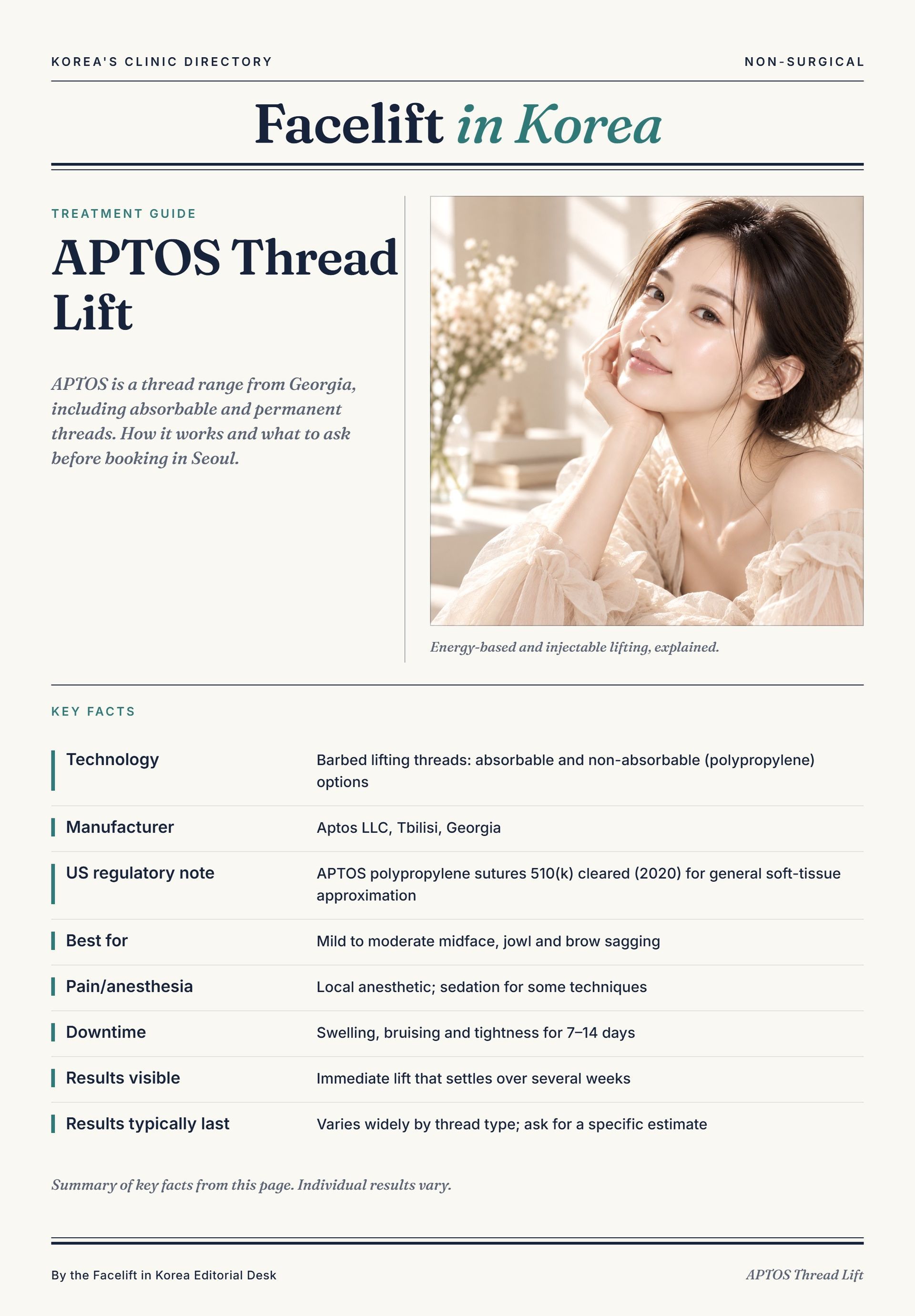
Key facts
| Technology | Barbed lifting threads: absorbable and non-absorbable (polypropylene) options |
|---|---|
| Manufacturer | Aptos LLC, Tbilisi, Georgia |
| US regulatory note | APTOS polypropylene sutures 510(k) cleared (2020) for general soft-tissue approximation |
| Best for | Mild to moderate midface, jowl and brow sagging |
| Pain/anesthesia | Local anesthetic; sedation for some techniques |
| Downtime | Swelling, bruising and tightness for 7–14 days |
| Results visible | Immediate lift that settles over several weeks |
| Results typically last | Varies widely by thread type; ask for a specific estimate |
| Price guide | Thread lift cost in Korea |
Read next
Reader questions
Frequently asked questions
Who makes APTOS threads?
APTOS threads are made by Aptos LLC, a company based in Tbilisi, Georgia. Its founders were among the early developers of barbed thread lifting.
Are APTOS threads permanent?
Some APTOS threads are permanent polypropylene, and others are absorbable. Ask the clinic which type it plans to use before agreeing to treatment.
Is the APTOS thread lift FDA approved?
APTOS polypropylene sutures received FDA 510(k) clearance in 2020 for general soft-tissue approximation. That is a general suture clearance, not a specific approval for cosmetic face lifting.
How long does an APTOS thread lift last?
Longevity varies widely with the thread type, technique and your tissue. Ask the doctor for an estimate specific to the product they plan to use.
Is APTOS better than PDO threads?
Neither is universally better. They differ in material, design and technique. The right choice depends on your anatomy, goals and the doctor's experience.
Next steps
Planning a facelift in Korea?
Compare clinics, check surgeon credentials and estimate your full trip budget before you book a consultation.
Facelift in Korea is an independent information directory. We do not perform procedures, and listings are not endorsements. This page is general information, not medical advice.